Why Does the Shoebill Stand Still for Hours? The Bird That Hunts by Waiting
On This Page▾

A shoebill stands still for hours because that is how it hunts. It plants itself over the water and waits, still as a statue, until a fish comes close. Then the whole bird falls forward onto it, bill first.
It looks like the world's most patient bird, and it is. The stillness is the plan.
Where Does a Shoebill Wait?
Somewhere the fish have to come to it. The shoebill lives in the freshwater swamps and papyrus marshes of eastern tropical Africa, from South Sudan and Uganda down to Zambia. It favors water that is low in oxygen, where fish have to rise to the surface for air more often. Its favorite prey, the lungfish, breathes air and can grow to about 6.5 feet long, so sooner or later it has to come up.
The bird also needs somewhere to stand. In deep water it hunts from a firm mat of floating plants, and in shallow water it likes tall plants to hide behind. Then it picks a spot and simply stops moving, sometimes for hours.
How Much of Its Day Is Spent Standing?
Nearly all of it, and it barely bothers to fly. Shoebills in Zambia's Bangweulu Wetlands were watched for 170 hours to see what they do all day. They spent 85 percent of their time standing, preening and sitting, 14 percent walking, and just 1 percent flying. The walking is the shoebill's other way to hunt: wading slowly through the shallows instead of waiting.
That is not a lazy bird. That is a bird saving every bit of energy for the one moment that counts. On average, a Bangweulu shoebill struck at something once every 2.2 hours and caught something once every 8.3 hours. That is a full workday of standing for one fish.
How Does a Shoebill Catch Its Food?
By collapsing. When a fish rises near the surface, the head and neck shoot forward into the water, and the whole five-foot bird overbalances and falls forward onto its prey with its bill wide open.
That fall is a one-shot move. After a collapse, a shoebill cannot strike again straight away. It has to get its balance back and start over from standing, so every strike counts.
In Bangweulu, most of them missed. Outside the breeding season, only 16 of 70 strikes worked, fewer than one in four. During the breeding season the birds did better: five of seven strikes landed.
A strike that works comes up messy. Along with the fish, the shoebill grabs a mouthful of weeds, so it sways its head from side to side to shake out the plants while it keeps hold of the catch. Then it usually bites the fish's head off before swallowing.
What Does a Shoebill Eat?
Big fish, mostly. Lungfish, tilapia, eels and catfish top the menu, and catfish made up 71 percent of what the Bangweulu birds caught, though lungfish are the prey shoebills go for wherever they can get them. Shoebills also take snakes, and even baby crocodiles and Nile monitor lizards.
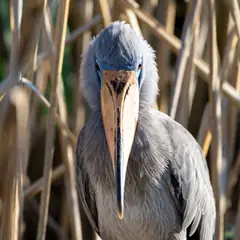
Prey like that calls for the bill the bird is named for. It is about a foot long and looks like a Dutch wooden clog, around five inches wide, with sharp edges and a sharp hook at the tip. Once it closes on a slippery fish, the fish is not going anywhere. The rest of the bird is built to match: a shoebill stands three and a half to five feet tall, with a wingspan of up to eight feet.
Is a Shoebill a Stork?
No, although people thought so for a long time. Shoebills were once classified as storks. They now have a family of their own, and their closest relatives are the pelicans.
They are quiet birds, too. Shoebills are silent most of the time, and around the nest or when greeting each other they clatter their bills instead of calling. Life runs slowly: usually only one chick survives to leave the nest, and a wild shoebill can live around 35 years. That slow pace matters, because only about 3,300 to 5,300 adults are left in the wild, and the species is listed as Vulnerable.
A shoebill does not chase anything. It finds the place where the fish have to come up for air, and it waits for them to do it.
Sources & Further Reading
Last reviewed 25 Nov 2026 · 5 sources
- National Geographic: Shoebill
- Audubon: The Shoebill, or the Most Terrifying Bird in the World
- Mullers and Amar, "Shoebill Balaeniceps rex foraging behaviour in the Bangweulu Wetlands, Zambia," Ostrich 86(1), 2015
- Animal Diversity Web, University of Michigan: Balaeniceps rex
- BirdLife International: Shoebill
Written by Michael Ryan
Mike keeps two rescued bearded dragons, Dex and Cera, and writes the care guides on BeastlyFacts from his own research and mistakes. He is not a veterinarian.
More about Michael Ryan →You May Also Like
More on the Shoebill
Beastfiles
More wild reads