Labrador Enrichment: A Gene Deletion Explains the Appetite
On This Page▾

The joke about Labradors and food turns out to have a specific molecular basis, and the research also tells you what to do about it.
A 14 base pair deletion in the POMC gene is associated with greater food motivation, higher body weight and more body fat in Labradors, with each copy worth about 0.33 standard deviations of weight. The useful part: the deletion is more common in assistance dogs than in pets, and those dogs stay lean, because they are active. Genetics set the appetite. Management sets the weight.
What the Research Says
Raffan and colleagues at the University of Cambridge published A deletion in the canine POMC gene is associated with weight and appetite in obesity-prone Labrador retriever dogs in Cell Metabolism in 2016.
The finding. A 14 base pair deletion in POMC, at an allele frequency of around 12 percent in Labradors, disrupting the beta-MSH and beta-endorphin coding sequences, and associated with body weight, adiposity and greater food motivation.
The size. Each deletion allele confers an increase of about 0.33 standard deviations in weight, an effect size the authors note is over three times the per-allele effect at the FTO locus in humans.
The other breed. Among other breeds tested, the deletion was found only in the closely related flat-coated retriever, where it has the same association.
The part that matters most. The mutation is significantly more common in Labradors selected to become assistance dogs than in pets. In those dogs the mutation increased food motivation, and they maintained a healthy body weight because of their regular physical activity.
That assistance dog result is not an accident of sampling. A dog that will work relentlessly for food is easier to train, so selection for trainability quietly selected for the appetite gene. The same variant that makes a pet Labrador fat makes a working one exceptional.
Use the Food Motivation
The reframe. A dog that will do almost anything for a piece of kibble is easy to enrich with food.
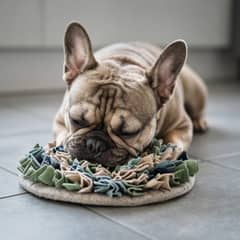
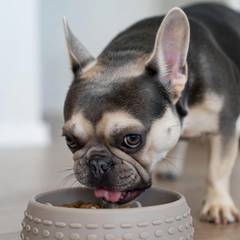
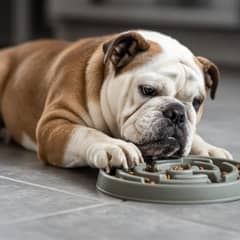
Move as much of the daily ration as possible into work. A puzzle toy, a snuffle mat, scatter feeding across the garden, and a stuffable rubber toy frozen with part of the meal.
The rule that makes it work: out of the ration, not on top of it. Weigh the food. A Labrador with the deletion is not going to self-regulate, and expecting it to is the failure the study explains.
Activity, Which Is the Other Half
The assistance dog finding is the argument. Those dogs carry the variant more often and stay lean because they are working regularly.
Daily, consistent, real activity. Not an escalating arms race the way it is for a border collie, just a genuine routine. Our guide to why your dog needs daily exercise covers the baseline, and our guide to pet obesity and body condition covers how to score whether it is working.
Body condition score beats the scales for this. Learn to feel the ribs.
Retrieving, Combined With Scent
Labradors retrieve enthusiastically and it is a good outlet. It gets considerably better when the retrieve has to be found first.
Hide the item, send the dog, let it search. That combines the breed's retrieving drive with the nosework finding in the dog enrichment guide, where scent work made dogs measurably more optimistic and heelwork did not.
Twenty minutes of that beats twenty ball throws, and it is easier on the joints.
Water
Most Labradors swim readily and love it, and swimming is genuinely useful here: high effort, low joint load, and it suits an overweight or arthritic dog that cannot run.
Rinse afterwards and dry the ears, since ear infections are common in this breed and water makes them likelier.
Joints, Alongside the Weight
Labradors are prone to hip and elbow dysplasia, covered in the hip and elbow dysplasia guide. Excess weight makes both worse.
That is why the feeding section and the exercise section are the same problem. Enrichment that keeps a Labrador lean is joint management.
Chewing
Strong chewers that need durable outlets, and chewing is calming. Match the chew to the dog and supervise, since Labradors swallow things, and foreign body surgery is one of the more common emergency presentations in the breed.
Priority Order
- Weighed food, delivered through puzzles, scatter feeding and scent work
- Consistent daily activity, since that is what keeps the carriers lean
- Retrieves that have to be found first
- Swimming where available
- Body condition scoring rather than trusting the eye
- Durable, supervised chewing
- Joint-aware exercise as the dog ages
What Not to Do
Do not free-feed a Labrador. Do not add enrichment food on top of meals. Do not treat the appetite as a training failure, since the research says otherwise. Do not rely on the dog to stop eating. Do not build the whole exercise routine on repetitive ball throwing. And do not leave swallowable items out with a breed this prone to eating them.
The dog enrichment guide covers the general case, and the pet obesity and body condition guide is how you score whether the routine is working on a breed that will eat its enrichment.
More on genetic testing is in our guide to pet DNA test results.
Sources & Further Reading
Last reviewed 14 Sep 2026 · 3 sources
- Raffan E et al. (2016). A deletion in the canine POMC gene is associated with weight and appetite in obesity-prone Labrador retriever dogs. Cell Metabolism
- A deletion in the canine POMC gene is associated with weight and appetite in obesity-prone Labrador retriever dogs. PubMed
- Duranton C and Horowitz A (2019). Let me sniff! Nosework induces positive judgment bias in pet dogs. Applied Animal Behaviour Science
Frequently Asked Questions
Is there research explaining why Labradors are so food obsessed?
Yes, and it is unusually specific. Raffan and colleagues at Cambridge found a 14 base pair deletion in the POMC gene in Labrador retrievers, at an allele frequency of around 12 percent, associated with body weight, adiposity and greater food motivation.
How big is the effect?
Each copy of the deletion added about 0.33 standard deviations of body weight, which the authors noted is more than three times the per-allele effect seen at the FTO locus in humans. It is a real effect rather than a curiosity.
Does that mean an overweight Labrador cannot be helped?
No, and the most useful part of the study is why. The deletion was significantly more common in Labradors selected as assistance dogs than in pets, and those dogs maintained a healthy body weight because of their regular physical activity. The genetics set the appetite. Activity and management set the weight.
So how should I feed a Labrador?
Weighed portions, and as much of the ration as possible delivered through work. A dog this food motivated is easy to enrich with food, which turns the trait from a liability into the thing that makes the enrichment straightforward.
Do Labradors need to retrieve?
It is a strong outlet rather than a requirement, and most Labradors take to it enthusiastically. It is worth combining with scent work, since a retrieve that has to be found first is a better use of twenty minutes than a ball thrown twenty times.
What should I watch for physically?
Joints and weight together. Labradors are prone to hip and elbow dysplasia, and excess weight makes both worse, so the food management and the joint health are the same problem viewed from two sides.
More on the Labrador
Recommended Gear
As an Amazon Associate I earn from qualifying purchases through the links above, at no extra cost to you.

Written by Michael Ryan
Mike keeps two rescued bearded dragons, Dex and Cera, and writes the care guides on BeastlyFacts from his own research and mistakes. He is not a veterinarian.
More about Michael Ryan →