Bloat in Dogs: The Emergency Every Large-Breed Owner Should Know
On This Page▾

Bloat is one of the leading killers of large and giant breed dogs, and one of the fastest-moving emergencies in veterinary medicine: a dog can go from acting slightly off to critical in a matter of hours. Knowing the early signs before you ever need them is the single best thing a large-breed owner can do.
What Bloat (GDV) Actually Is
Bloat starts simply: the stomach fills with gas, food, or fluid and expands, putting pressure on nearby organs and the diaphragm. On its own, that's gastric dilatation. The truly dangerous version is GDV, gastric dilatation-volvulus, where the distended stomach also rotates on its axis. That twist seals off both ends of the stomach, cuts off its blood supply and the spleen's along with it, and blocks blood from returning properly to the heart. Shock follows fast.
A dog's stomach can rotate anywhere from 90 to a full 360 degrees during a GDV episode, and the degree of twist has a real effect on how quickly tissue damage sets in. That is part of why minutes genuinely matter once symptoms start.
Why Deep-Chested Breeds Are Especially Vulnerable
A deep, narrow chest gives the stomach more room to swing and rotate than a broader, shallower one does. That's the main reason Great Danes, Standard Poodles, and Weimaraners sit at the top of nearly every bloat risk list, even though the condition can technically happen in any dog, deep-chested or not.
Risk Factors
| Risk Factor | Why It Matters |
|---|---|
| Deep, narrow chest conformation | Gives the stomach more room to rotate |
| One large meal per day | Distends the stomach faster than smaller, frequent meals |
| Eating rapidly | Swallowed air adds directly to gas buildup |
| Exercise right before or after eating | Raises the chance of a full stomach twisting |
| Family history of GDV | Genetics play a real role independent of conformation |
| Older age and general stress | Both are independently linked to higher incidence |
Early Warning Signs
- Restlessness and pacing: unable to get comfortable or settle down.
- Unproductive retching: trying to vomit with little or nothing coming up, one of the most classic GDV signs.
- A visibly swollen or distended abdomen, sometimes firm to the touch.
- Excessive drooling, more than normal.
- Rapid, shallow breathing.
- Pale gums and a climbing heart rate as shock begins to set in.
Why This Is Always an Emergency
There's no "wait and see" with bloat. Mortality climbs with every hour treatment is delayed, and a dog that looks merely uncomfortable in the morning can be in shock by evening. Any large or giant breed dog showing unproductive retching alongside a distended abdomen needs an emergency vet immediately, not a phone call at the next available appointment.
Treatment
At the vet, the first priority is decompressing the stomach and stabilizing the dog for shock with IV fluids. If imaging confirms the stomach has actually twisted, emergency surgery follows to untwist it, and a gastropexy is typically performed at the same time to tack the stomach in place and prevent it from happening again. Dogs treated quickly have a meaningfully better survival rate than those brought in after hours of delay.
Prevention That Actually Works
- Feed multiple smaller meals instead of one large one.
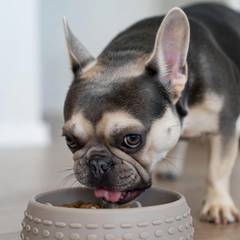
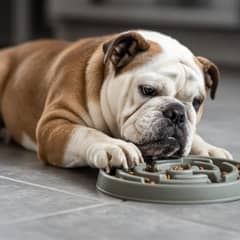
- Use a slow-feeder bowl to cut down on rapid eating and swallowed air.
- Avoid strenuous exercise right before and after meals. That's a timing rule, not a reason to cut back on activity overall, and our guide on why your dog needs daily exercise covers how to schedule walks and hard play around feeding times.
- Talk to your vet about a preventive gastropexy if you own a high-risk breed, especially around the time of a spay or neuter.
- Skip the raised bowl: it isn't proven to help, and some research ties it to higher risk instead.
None of this eliminates risk entirely, but it meaningfully lowers it, and knowing the warning signs means you'll act in minutes rather than hours if it happens anyway. The German shepherd feeding guide puts the meal-splitting habit above into practice for a classic high-risk breed.
Sources & Further Reading
Last reviewed 9 Jul 2026 · 4 sources
- Merck Veterinary Manual: Gastric Dilation and Volvulus in Small Animals
- American College of Veterinary Surgeons: Gastric Dilatation-Volvulus
- American Kennel Club: Bloat in Dogs
- Glickman LT, Glickman NW, Schellenberg DB, Raghavan M and Lee T (2000). Non-dietary risk factors for gastric dilatation-volvulus in large and giant breed dogs. Journal of the American Veterinary Medical Association 217(10):1492-1499
Frequently Asked Questions
What's the difference between bloat and GDV?
Bloat on its own just means the stomach has filled with gas, food, or fluid and distended. That is uncomfortable, but not always immediately fatal. GDV (gastric dilatation-volvulus) is what happens when that distended stomach also twists on itself, cutting off its own blood supply along with the spleen. Plain bloat can progress into GDV within hours, which is why both are treated as emergencies rather than waiting to see which one it is.
Which breeds are most at risk?
Deep-chested large and giant breeds top the list: Great Danes, Standard Poodles, German Shepherds, Weimaraners, Saint Bernards, and Doberman Pinschers among them. Labradors and other moderately deep-chested large breeds carry some risk too, just less than the extreme cases. Chest depth relative to width matters more than raw body size.
Does raising food bowls prevent bloat?
No, and this is one of the more persistent pieces of outdated advice still floating around. A widely cited Purdue University study actually found elevated bowls associated with higher bloat risk in at-risk breeds, not lower. Feeding from a normal, floor-level bowl is the current recommendation.
Can bloat happen without a big meal?
Yes. Stress, eating too fast, and exercising right after a meal all play a role independent of how much food was actually eaten, and genetics matters too: dogs with a first-degree relative that bloated are at higher risk regardless of feeding habits.
Is preventive gastropexy surgery worth it for high-risk breeds?
For many high-risk breeds, yes. Vets often recommend it, sometimes performed at the same time as a spay or neuter to avoid a second anesthesia event. A gastropexy doesn't stop the stomach from filling with gas, but it tacks the stomach to the abdominal wall so it can't twist, which is the part that actually kills. That single change dramatically lowers the odds of a fatal outcome.
Recommended Gear
As an Amazon Associate, we earn from qualifying purchases through the links above - at no extra cost to you.

Written by Michael Ryan
Mike keeps two rescued bearded dragons, Dex and Cera, and writes the care guides on BeastlyFacts from his own research and mistakes. He is not a veterinarian.
More about Michael Ryan →