Why Wombats Produce Cube-Shaped Droppings, and How Researchers Worked It Out
On This Page▾

Almost every animal on Earth produces droppings shaped like a cylinder or a pellet. The bare-nosed wombat (Vombatus ursinus) produces cubes. Not vaguely angular, not roughly blocky. Flat faces, beveled edges, four clean corners in cross section, at a rate of 80 to 100 a night.
The researchers who explained it called the ability unique in the animal kingdom. The answer is not the one most people guess, and it took a CT scanner, dissections and a mathematical model to pin down.
The Answer Everyone Assumes, and Why It Is Wrong
If you make pasta, the shape comes from the die you push it through. Square hole, square noodle. So the intuitive guess is that a wombat has a square anus.
That guess had company. Others proposed the material was compressed between the pelvic bones, or that blocks of longitudinal muscle in the caecum did the shaping. As the research team pointed out, every one of these ideas remained speculation. Nobody had gone and looked.
In 2019, a group led by Patricia Yang and David Hu at Georgia Tech, working with Scott Carver at the University of Tasmania, put a live adult female wombat through a CT scanner. The anus is round, like every other animal's. The pelvic bones are nowhere near the colon.
Extrusion was out. Whatever makes the cube happens upstream, inside a soft, flexible tube.
Two Corners Too Few
The first public account came at the American Physical Society's fluid dynamics meeting in November 2018, in a talk titled "How do wombats make cubed poo?" The team had inflated sections of wombat intestine with long balloons and measured how much the wall stretched at different points around the circumference. Local strain ran from about 20 percent at the cube's corners to about 75 percent at its edges. Stiff spots and stretchy spots, and the stiff spots seemed to line up with the corners.
That work won the 2019 Ig Nobel Prize in Physics, awarded to Yang, Alexander Lee, Miles Chan, Alynn Martin, Ashley Edwards, Carver and Hu "for studying how, and why, wombats make cube-shaped poo."
Then the full study came out in Soft Matter in 2021, and the tidy version fell apart. Histology and tensile testing showed the intestinal wall has two stiff bands, sitting 180 degrees apart. Two stiff bands should give you two corners. A square needs four.
The extra two come from an effect nobody predicted. When the stiff bands contract, they pull the tissue next to them inward. The points furthest from the stiff bands, in the middle of the soft regions, get left behind by their own mass. That lag creates its own peak in curvature. So two corners are pushed, and two are dragged.
Where the Cube Actually Forms
Dissections of three wombats, all animals killed by vehicles in Australia between 2018 and 2020, located the process in the last 17 percent of the intestine.
That intestine is long. A fully grown bare-nosed wombat has 6 to 9 meters of it, feeding a hindgut fermentation system that squeezes a living out of grasses and sedges. In the proximal colon the contents are a yellow-green slurry with no shape at all. By the distal colon, they are dark, dry and cubic.
Measured directly, the difference is stark.
| Sample location | Water content | Shape |
|---|---|---|
| Wombat proximal colon | 0.81 | Yellow-green slurry, amorphous |
| Wombat distal colon (last meter) | 0.53 | Fully formed cubes |
| Human feces (for comparison) | 0.74 | Cylindrical |
The tissue itself does the sculpting. In the distal colon, the longitudinal muscle layer more than doubles in thickness around the circumference, and tensile testing found the stiffest region is four times stiffer than the softest. Ordinary peristalsis does the rest. A normal intestine contracts evenly because it is uniform; a wombat's does not, so the same rhythmic squeezing works the same four points over and over. With contractions every couple of seconds across roughly five days of transit, a single cube experiences on the order of 100,000 of them.
Dryness is the other half of the answer, and it is not optional. The team found cubes only in the distal colon, never in the proximal colon, even though both regions have the periodic muscle thickening. Wet material will not hold a corner. A follow-up study by the same lab found that across 22 mammal species, droppings switch from cylindrical to pelleted once fecal water content drops below 0.65. Wombats sit at 0.53. Humans sit at 0.74, on the wrong side of the line.
The model makes a testable prediction. Run the simulation with three stiff bands instead of two and it produces a hexagon. Four bands would give an octagon. As the authors put it, an animal with three or four periods of stiffness around its intestine should produce hexagonal or octagonal prisms. Nothing known does, but the physics does not forbid it.
So Why Bother Making Cubes?
Wombats deposit their droppings in aggregations called latrines, placed at burrow entrances and on prominent features: a rock, a log, a slight rise, a game trail. Elevated, in other words, and a rounded dropping on a rock has an obvious problem.
The team tested this with dough models shaped and sized like real wombat scats, dropped from 20 cm, roughly the height of an adult wombat's rear. On an 8 degree slope, the cubes ended up an average of 20 cm closer to the impact point than spheres did. On flat ground the cubes actually traveled further, so the advantage is specific to the sloped, raised surfaces wombats choose.
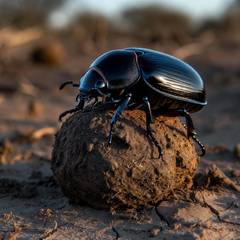
Wombats are not the only animal whose relationship with dung turns out to be unexpectedly sophisticated. Dung beetles roll their ball in a straight line by steering off the Milky Way, which was demonstrated by putting beetles in a planetarium.
One correction is worth making, because the popular version of this fact gets it wrong. Wombat latrines are almost always called territorial marking. A 2024 review in the Annual Review of Animal Biosciences lists territoriality among the myths about this species: home ranges overlap substantially and there is no evidence of territorial defense. The scats are still communication, and probably carry identity, sex, age, burrow use and reproductive status, but "keep out" does not appear to be the message.
What Else Holds Up, and What Does Not
The same review is a useful filter for the rest of the wombat trivia, and several favorites do not survive it.
The famous armored rump, usually described as a cartilage plate used to block burrows, is listed as a myth. A cartilaginous plate does not show up on X-rays, and dissections show the hardening is fascia, which is fibrous connective tissue. The rump is genuinely tough and genuinely used as a shield, but the anatomy is not what the story claims. Whether wombats crush predators against the burrow roof is contested outright: the Australian Museum and the Tasmanian government both state it plainly, while the 2024 review classes it as anecdotal with the evidence lacking.
The backwards pouch is real. It opens to the rear when distended, which is the state that matters for a joey. The usual explanation, that this keeps soil out while the mother digs, is more assumption than finding, and the review notes that a quiescent pouch lies flat against the body and is not strictly rear-facing at all. It is a plausible story nobody has tested, a bit like the alpha wolf idea before anyone checked it.
Digestion is often quoted as taking two weeks. Published measurements put mean food passage retention at roughly 40 to 80 hours, against about 50 hours for a 100 kg human. The wombat's real extreme is metabolic: field metabolic rates run 40 to 60 percent of the prediction for a herbivorous mammal over 10 kg, among the lowest known at that size.
Wombats are not the only animal whose toilet habits turn out to be load-bearing. A sloth climbs all the way down to the forest floor to defecate, a weekly trip that is the single most dangerous thing it does, and the explanation is stranger than the behavior.
Which is the pattern with wombats, and with other strange Australian mammals. The real biology is stranger and more specific than the version that gets repeated. A soft tube with uneven walls, contracting a hundred thousand times on drying material, producing a shape that stays put on a rock. Nobody would have guessed that, which is why it took until 2021 to find out.
We keep a full profile in the Beastlypedia wombat file.
Sources
Last reviewed 30 Jul 2026 · 10 sources
- Intestines of non-uniform stiffness mold the corners of wombat feces, Soft Matter 17:475-488 (Yang, Lee, Chan, Kowalski, Qiu, Waid, Cervantes, Magondu, Biagioni, Vogelnest, Martin, Edwards, Carver and Hu, 2021)
- Intestines of non-uniform stiffness mold the corners of wombat feces (PubMed record, PMID 33289747)
- How do wombats make cubed poo? Abstract E19.00001, 71st Annual Meeting of the APS Division of Fluid Dynamics, November 2018
- Winners of the Ig Nobel Prize, 2019 Physics Prize (Improbable Research)
- Drying dynamics of pellet feces, Soft Matter 19:723-732 (Magondu, Lee, Schulz, Cervantes Buchelli, Meng, Kaminski, Yang, Carver and Hu, 2023)
- The Distinctive Biology and Characteristics of the Bare-Nosed Wombat (Vombatus ursinus), Annual Review of Animal Biosciences 12:135-160 (Carver, Stannard and Martin, 2024)
- Bare-nosed Wombat (Department of Natural Resources and Environment Tasmania)
- Bare-nosed Wombat (The Australian Museum)
- Wombats (NSW Department of Climate Change, Energy, the Environment and Water)
- Hindgut fermentation in the wombats: two marsupial grazers, Journal of Comparative Physiology B 162:561-566 (Barboza and Hume, 1992)
Written by Michael Ryan
Mike keeps two rescued bearded dragons, Dex and Cera, and writes the care guides on BeastlyFacts from his own research and mistakes. He is not a veterinarian.
More about Michael Ryan →Comments
No comments yet - be the first!