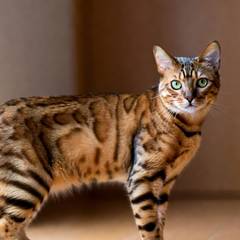
Cat Enrichment: Five Pillars, and Most Homes Miss the Second One
On This Page▾

Cats have something dogs mostly do not: an agreed veterinary framework for what their environment has to provide.
The AAFP and ISFM Feline Environmental Needs Guidelines set out five pillars of a healthy feline environment. The one most homes fail is the second: multiple and separated key resources. Food, water, litter, scratching and resting places all bunched in one corner is one resource, not five, and it forces the cat into trade-offs it should not have to make.
What the Guidelines Set Out
Ellis, Rodan, Carney, Heath, Rochlitz, Shearburn, Sundahl and Westropp published the AAFP and ISFM Feline Environmental Needs Guidelines in the Journal of Feline Medicine and Surgery in 2013. It is one of the most-cited documents in feline medicine and it organizes the whole question into five pillars.
- A safe place. Somewhere the cat can retreat to and feel secure, ideally elevated and enclosed.
- Multiple and separated key environmental resources. Food, water, toileting areas, scratching areas, play areas and resting places, provided in multiples and in separate locations.
- Opportunity for play and predatory behavior.
- Positive, consistent and predictable human to cat social interaction.
- An environment that respects the cat's sense of smell.
The guidelines' own framing is that a cat's comfort with its environment is intrinsically linked to its physical health, and that getting this right reduces stress-related disorders as well as unwanted behavior. That link is the part worth taking seriously: this is not a comfort checklist, it is preventive medicine.
The reason this exists as a veterinary document rather than a lifestyle one is that feline stress presents as illness. Idiopathic cystitis, over-grooming and inappetence are environmental problems that arrive at the vet looking like medical ones, which is why the profession wrote the environment guidelines itself.
The case for why any of this matters is in our article on why cats need mental enrichment.
Separate the Resources
The pillar most homes fail, and it is free to fix.
Food and water in different places, not side by side, since cats generally prefer not to drink next to where they eat. Litter trays away from both, in separate locations, never in a row. Scratching posts near sleeping and entry points, where cats actually want to scratch. Resting places at several heights around the home.
In a multi-cat home this is the whole ballgame. Two trays beside each other are one resource that one cat can guard. Two trays at opposite ends of the house are two. The standard recommendation is one tray per cat plus one, separately sited.
Vertical Space and Safe Places
Pillars one and two at the same time. A cat tree gives height to observe from, somewhere enclosed to retreat into, and a scratching surface.
Height multiplies territory without needing more floor, which matters most in small homes and multi-cat households. Shelves, window perches and the tops of furniture all count.
A safe place has to be somewhere the cat can be left alone in. A retreat that gets reached into is not a retreat.
Predatory Play, Finished Properly
The third pillar, and the detail that gets missed is the ending.
A wand toy moved like prey, in short bursts with pauses, ending in a catch the cat is allowed to have, runs the full sequence: stalk, chase, pounce, grab. A laser pointer runs the sequence and never lets it resolve, which is why some cats get visibly frustrated with them. If you use one, finish by landing the dot on a physical toy the cat can catch.
Several short sessions a day beat one long one. Cats hunt in bursts. Rotate toys so they stay novel, and store the ones not in use.
Food That Takes Work
Cats in the wild make many small kills a day. A bowl filled twice removes all of it.
A puzzle feeder puts part of the ration behind a problem. Scatter feeding, food hidden around the house, and treat balls do the same thing more cheaply. Start easy, since a cat that fails at a puzzle simply stops trying.
Take it out of the daily ration. None of it goes on top. Our guide to pet obesity and body condition covers why that matters, and indoor cats are the population it hits hardest.
Predictable Human Interaction
The fourth pillar is about consistency and the cat's choice, not quantity. Let the cat initiate contact and end it. Handle in ways an individual cat likes rather than in ways cats are supposed to like.
Predictable routines around feeding, play and quiet time do more for a nervous cat than any object. Our guide on pacing and hiding covers what it looks like when this pillar is missing.
Respect the Nose
The fifth pillar, and the one that sounds soft until you understand what scent does for a cat. Facial marking on furniture and corners is how a cat makes a space its own.
Practically: do not scrub every surface a cat has marked, do not deep-clean everything at once, keep strong-smelling cleaners away from resources, and introduce new furniture gradually. Litter changes count here too, since a cat that dislikes a new litter's smell stops using the tray.
Scratching, Provided Deliberately
A normal behavior that is going to happen. Posts tall enough for a full stretch, stable enough not to wobble, in the places cats want to scratch, which is near sleeping spots and entrances. The corner you would prefer is not one of them.
Offer more than one surface type, since cats differ on sisal, cardboard and carpet, and some want a horizontal surface where others want a vertical one.
Priority Order
- Key resources separated across the home, not stacked in one corner
- One litter tray per cat plus one, in separate locations
- Safe elevated retreats the cat can be left alone in
- Short daily predatory play sessions that end in a catch
- Part of the ration delivered through puzzles and scatter feeding
- Scratching surfaces where the cat wants them
- Consistent, cat-led human interaction and a stable scent environment
What Not to Do
Do not stack food, water and litter in one corner. Do not line litter trays up together and count them as separate. Do not rely on a laser pointer that never lets the cat catch anything. Do not reach into a cat's retreat. Do not deep-clean every marked surface at once. Do not add enrichment food on top of a full bowl. And do not read a cat that hides all day as simply shy, since that is often the first pillar failing.
Some breeds need these same pillars at a scale that catches households out, which our Bengal enrichment guide covers.
Two more breeds get their own version of this page, the Sphynx and the Persian, where breed traits change what is practical.
Sources & Further Reading
Last reviewed 8 Sep 2026 · 4 sources
- Ellis SLH, Rodan I, Carney HC, Heath S, Rochlitz I, Shearburn LD, Sundahl E and Westropp JL (2013). AAFP and ISFM Feline Environmental Needs Guidelines. Journal of Feline Medicine and Surgery
- 2013 AAFP/ISFM Environmental Needs Guidelines. American Association of Feline Practitioners
- Five pillars of a healthy feline environment. dvm360
- Feline environmental needs guidelines. VCA Animal Hospitals
Frequently Asked Questions
Is there an agreed standard for cat environments?
Yes. The American Association of Feline Practitioners and the International Society of Feline Medicine published Feline Environmental Needs Guidelines, which set out five pillars of a healthy feline environment covering safety, resources, play, human interaction and scent.
What are the five pillars?
A safe place. Multiple and separated key environmental resources. Opportunity for play and predatory behavior. Positive, consistent and predictable human to cat social interaction. And an environment that respects the cat's sense of smell.
Which one do most homes get wrong?
The second. Food, water, litter trays, scratching posts and resting places tend to get grouped in one corner or one room, and separating them is what stops a cat having to make a trade-off between eating, drinking, toileting and feeling safe.
How many litter trays should I have?
The standard veterinary recommendation is one per cat plus one, in separate locations rather than lined up together. Two trays side by side function as one resource, which is exactly what the second pillar is warning about.
Does play need to be predatory?
That is what the third pillar specifies, and it matches what cats do. A wand toy moved like prey, allowed to end in a catch, engages a full hunting sequence. A laser pointer that never lets the cat catch anything ends the sequence without resolution.
Do indoor cats need vertical space?
Yes, and it is one of the cheapest fixes. Height gives a cat somewhere to observe from and somewhere to retreat to, which serves the first pillar directly, and in multi-cat homes it multiplies the usable territory without needing more floor.
Recommended Gear
As an Amazon Associate I earn from qualifying purchases through the links above, at no extra cost to you.
Written by Michael Ryan
Mike keeps two rescued bearded dragons, Dex and Cera, and writes the care guides on BeastlyFacts from his own research and mistakes. He is not a veterinarian.
More about Michael Ryan →