10 Surprising Cuttlefish Facts

Cuttlefish are often overshadowed by octopuses, but they are every bit as fascinating and in some ways even more impressive. With lightning-fast camouflage and strange abilities, these masters of disguise have plenty of surprises. Here are ten facts worth knowing.
-
They are masters of camouflage. Cuttlefish can change color, pattern, and skin texture in a fraction of a second to perfectly match their surroundings. Some can even make their skin look like moving sand or coral. They manage it without seeing color: the common cuttlefish has a single visual pigment, and in tests on checkerboards of matched brightness it treated blue and yellow squares as one uniform background.
-
They have unique W-shaped pupils. Their eyes have a distinctive W-shaped pupil that helps them see well in varying light conditions and may improve contrast detection. Depth is handled by both eyes together. Researchers fitted cuttlefish with tiny red and blue 3D glasses and showed they judge distance by comparing the two eyes' views, striking faster and from a shorter distance when that information was intact. The method differs from the human one, since cuttlefish pulled depth from images that would confuse a person. Strange eyes are something of a theme in the ocean, and the mantis shrimp sits at the other extreme, a crustacean with 16 types of photoreceptor that can read polarized light.
-
They are not fish. Despite the name, cuttlefish are cephalopods, molluscs in the same group as squid and octopus, and share their copper-based blue blood. The deep-water members of the group push that body plan much further, down to the giant squid and its dinner-plate eyes.
-
They can hypnotize prey with color. Some cuttlefish use pulsing color patterns to confuse or “hypnotize” prey like shrimp before striking. The moving waves of color hold the prey’s attention just long enough.
-
They have a built-in buoyancy device. Cuttlefish have an internal shell called a cuttlebone. By adjusting gas and liquid inside it, they can control their buoyancy and hover effortlessly in the water.
-
They are surprisingly intelligent. In a delay test, cuttlefish passed up a food reward in front of them to wait for a better one, holding out for 50 to 130 seconds. The ones that waited longest also learned a reversal task faster. That is the same range of self-control seen in some large-brained vertebrates.
-
Most live only 1-2 years. Like many cephalopods, cuttlefish have short but intense lives. They grow quickly, reproduce once, and die shortly afterward.
-
Males put on flashy displays. During mating season, males display bright, shifting color patterns to attract females and warn off rivals. Some smaller males even disguise themselves as females to sneak past bigger competitors.
-
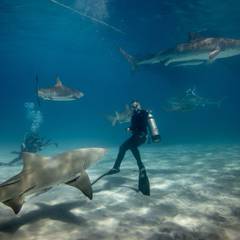
Their ink serves multiple purposes. When threatened, cuttlefish release ink that can confuse predators, though a smokescreen only does so much against hunters that track prey by scent and electrical fields, which is exactly how sharks find a meal in murky water. Some also release a “dummy” ink cloud that looks and moves like a cuttlefish, acting as a decoy while the real one escapes.
-
They can walk on their arms. Cuttlefish often use their arms to crawl along the seafloor in a walking motion. Combined with their camouflage abilities, this makes them incredibly stealthy hunters.
Cuttlefish can change their appearance so quickly and accurately that they can effectively disappear while sitting completely still in plain sight.
Which fact surprised you? Tell me in the comments.
Sources
Last reviewed 26 Jun 2026 · 3 sources
- Mäthger et al. (2006), Color blindness and contrast perception in cuttlefish (Sepia officinalis) determined by a visual sensorimotor assay, Vision Research
- Feord et al. (2020), Cuttlefish use stereopsis to strike at prey, Science Advances
- Schnell et al. (2021), Cuttlefish exert self-control in a delay of gratification task, Proceedings of the Royal Society B

Written by Michael Ryan
Mike keeps two rescued bearded dragons, Dex and Cera, and writes the care guides on BeastlyFacts from his own research and mistakes. He is not a veterinarian.
More about Michael Ryan →