Axolotl
Ambystoma mexicanum
On This Page▾
🌍 Overview
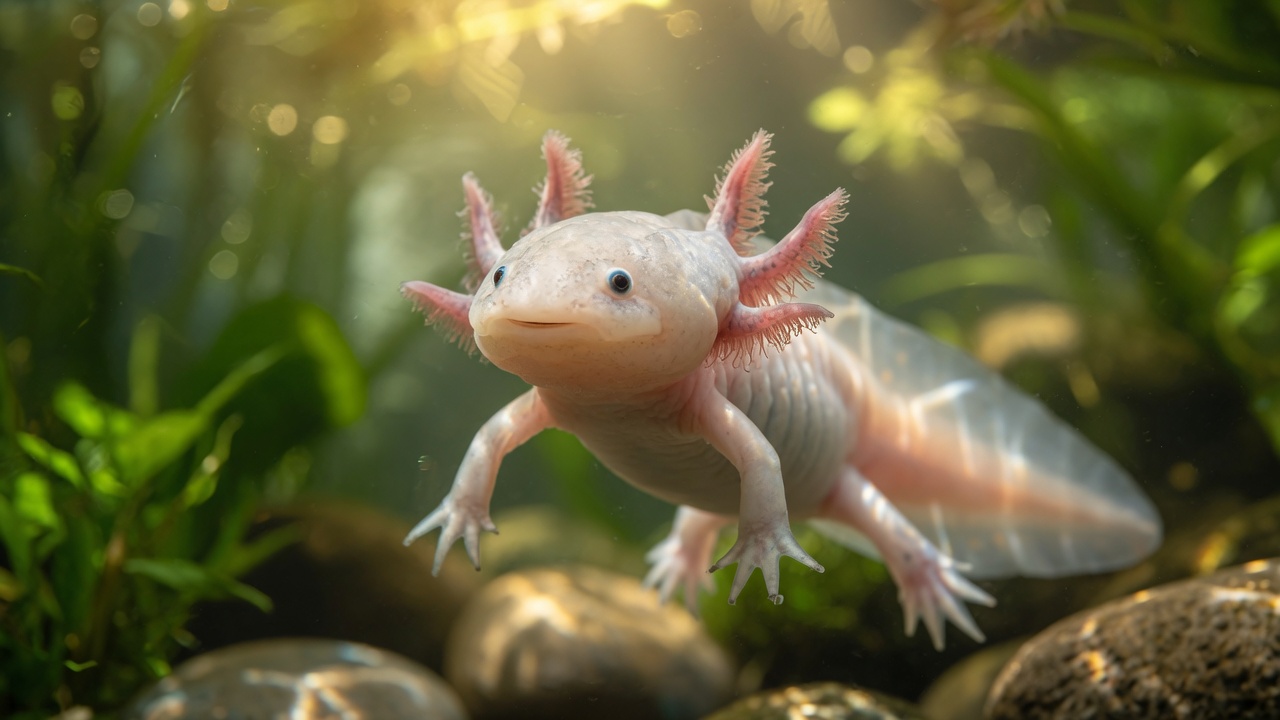
The axolotl is a neotenic salamander - a species that retains larval features (gills, aquatic lifestyle) permanently throughout its adult life, never undergoing metamorphosis. Technically it remains a permanently juvenile form. Endemic to the lake complex of Xochimilco near Mexico City, the axolotl is Critically Endangered in the wild with fewer than 1,000 individuals estimated remaining. Millions are kept in captivity for biomedical research (their regenerative abilities are extraordinary) and as pets.
📋 Quick Facts
Native Range
Lake Xochimilco, Mexico City, Mexico
Natural Habitat
Freshwater lake and canal system
Adult Size
9-12 inches (23-30 cm)
Wild Diet
Worms, mollusks, insects, small fish, and aquatic invertebrates
Wild Lifespan
5-6 years (habitat degradation and predation cut wild lifespans well short of the 10-15 years typical in captivity)
Conservation Status
Critically Endangered (IUCN)
📜 History
The name comes from Nahuatl, joining atl for water with the name of Xolotl, the dog-headed Aztec god who, in Bernardino de Sahagun's account, took this form to escape sacrifice. The laboratory animal begins with a single shipment: in 1864, 34 live axolotls were sent from Mexico City to Paris and split between the Jardin d'Acclimatation and the Museum d'Histoire Naturelle, where six went to Auguste Dumeril. They bred so freely that Dumeril counted about 800 within a year, and their offspring went out to institutions across Europe, which is why most laboratory axolotls descend from those six. The albinism behind the pink-eyed white form came later, from a wild albino tiger salamander found in Minnesota and crossed in, work documented by Humphrey in 1967.
⚖️ Compare
Axolotl
Human
Adult Size
9-12 inches (23-30 cm)
5-6 feet (150-185 cm); ~135-200 lbs
Wild Lifespan
5-6 years (habitat degradation and predation cut wild lifespans well short of the 10-15 years typical in captivity)
~73 years (global average)
Wild Diet
Worms, mollusks, insects, small fish, and aquatic invertebrates
Omnivorous - eats just about anything
Native Range
Lake Xochimilco, Mexico City, Mexico
Global - originated in Africa roughly 300,000 years ago
Natural Habitat
Freshwater lake and canal system
Everywhere from arctic tundra to tropical megacities
Conservation Status
Critically Endangered (IUCN)
Least Concern (8+ billion and counting)
🧠 Test Yourself
What's the Axolotl's native range?
🤩 Fun Facts
🦎 Axolotl Superpowers
Axolotls can regenerate entire limbs, their heart, spinal cord, and even parts of their brain with zero scarring! Scientists study them hoping to unlock regeneration secrets for humans.
🦎 Forever Young, Forever Underwater
Axolotls never grow up in the usual salamander sense. Thanks to a trait called neoteny, they keep their feathery gills and stay fully aquatic for their entire lives, reaching adulthood without ever setting foot on land. Sadly, the wild population now survives in just one place, a shrinking canal system near Mexico City.
📖 Care Guide
Axolotl Care Guide
The 'forever larva' with feathery gills and superhero-level regeneration!
⚖️ Where it is legal
14 US jurisdictions restrict this species, from outright bans to permits. Every one quotes the rule it comes from.
⚖️ Legal Guide
Subscribe - it's free
New animal facts and care guides straight to your inbox. No spam. 🐾
📰 Deep Dive
🦎 How Much Does an Axolotl Really Cost?
🦎 Should You Handle an Axolotl? Only When You Truly Have To
🦎 Common Axolotl Health Issues (Most Trace Back to Temperature)
🦎 Axolotl Tank Setup: Cold Water and No Gravel
🦎 Axolotl Feeding: Schedule, Diet, and the Substrate Mistake That Matters Most
🦎 Axolotl Enrichment: Hides, Foraging, and Safe Novelty
🩺 Health and More
🐠 Aquarium Power Outages, Transport, and Moving Your Fish: The Complete Plan
🦠 How to Cycle a Fish Tank, Start to Finish: Fishless and Fish-In
🧼 Salmonella and Reptile Hygiene: The Rules That Actually Matter
🧽 Aquarium Filtration: How It Actually Works and How to Maintain It
🪣 Aquarium Water Changes: How Much, How Often, and What the Number Is For
🧪 Freshwater pH, GH, and KH: Why Chasing a Number Backfires
🩺 Fish Quarantine and Treatment: The Hospital Tank Guide
🩺 How to Tell If Your Fish Is Sick: Waste, Behavior, and Body Signs
🛁 Tubbing, Cooling, and Salt Baths for Sick Axolotls
🧊 Cooling an Aquarium Without a Chiller
🧪 Amphibian Quarantine, Acclimation, and Water Hardness: The Full Guide
🐾 Four Pets That Break the Usual Mold
⚖️ Four Pets Whose Size Tells You the Wrong Thing
🦎 Tiger Salamander vs. Axolotl: Which Salamander Actually Fits Your Setup
🤓 Did You Know?
Axolotls are neotenic, meaning they retain their larval (juvenile) features throughout their entire adult life and never undergo full metamorphosis. They keep their feathery external gills, tail fins, and aquatic lifestyle permanently. Scientists study them intensively because they can regenerate not just limbs but heart tissue, spinal cord sections, and parts of their brain with zero scarring.
Explore More