How to Handle and Tame a Budgie
On This Page▾

How you approach handling depends a lot on where your budgie came from. A hand-raised bird is already comfortable with people and may step up on its own from day one. A parent-raised or previously untamed budgie needs a slower, more deliberate process, and rushing it sets you back.
Age Sets the Pace
A young budgie from a breeder who has handled it regularly is the easiest bird to tame. Pet store budgies tend to be older, and older budgies take longer. Two features date a budgie at a glance: the barring on the forehead recedes as the bird ages, and the iris, dark in a youngster, turns gray. A bird with full forehead bars and solid dark eyes is a young one.
Let It Settle First
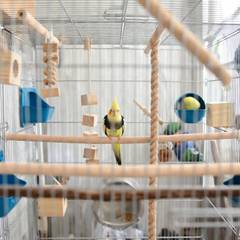
Give a new budgie a week or two to adjust before attempting any taming. Position the cage near eye level and against a wall rather than in an open, exposed spot, movement happening above or behind a caged bird triggers a real predator-response fear that makes taming much harder.
If other birds already live in the house, those settling weeks overlap quarantine. The new budgie spends 30 to 45 days in a separate room, and taming can begin there once it has settled, provided it is handled last each day, after the resident birds, which is the order the quarantine routine is built on. Holding off until quarantine ends only adds a month to the process.
The Taming Progression
Work through this roughly in order, moving to the next step only once your budgie is calm at the current one:
- Hand in the cage. Spend time with your hand resting inside the cage, not reaching for the bird, just present, until your budgie stops reacting to it.
- Millet from your fingers. Offer a favorite treat, spray millet works well for most budgies, held still and close enough that your bird has to approach to reach it. Break the spray into short pieces rather than offering a whole one, since millet is a treat to keep to small quantities, as the budgie feeding guide explains.
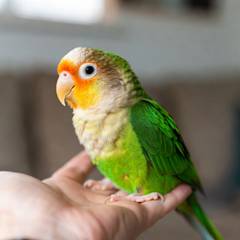
- Step-up training. Once your budgie is comfortable taking food from your hand, gently press a finger against its lower chest/feet area and offer the step-up cue.
Speak softly throughout this process, and keep sessions short and low-pressure.
A hand held still inside the cage, doing nothing at all, is often the single most effective taming tool for a nervous budgie. It gives the bird full control over when to investigate, which matters enormously to a prey species that reads any sudden approach as a threat.
What Not to Do
Skip any advice about forcing handling or "establishing dominance" over your bird. That approach is outdated and actively counterproductive, budgies are prey animals, and dominance-based handling just teaches them that hands are a threat.
If you need to restrain your budgie briefly, for medication or a health check, use a small towel rather than your bare hands, the same towel hold used for nail trims. A towel protects both the bird and the handler, and it keeps the negative association with the towel instead of with you directly.
The First Flight Out
A budgie that steps up reliably is ready to come out of the cage, and the room gets checked before the door opens. Ceiling fans off, windows shut, and nothing within reach that a chewing bird can hurt itself on.
Signs of Stress
- Frantic flapping
- Panting or open-mouth breathing
- Repeatedly fleeing from your hand
If you see these, stop and try again later. Progress that happens on the bird's timeline holds up much better than progress forced.
Adding a Second Budgie
The companion that works is another budgie, and the introduction runs in stages:
- A vet exam for the new bird as soon as it comes home, before the resident is exposed to it, then 30 to 45 days in a separate room for the full bird quarantine.
- Both cages in one room, a distance apart, so the birds get used to the sight and sound of each other. Move the cages closer over the following days to weeks.
- The first time together happens under strict supervision, and any fighting or bullying means separating them on the spot.
Some pairs never accept each other. Two budgies that still fight after weeks of side-by-side cages live in separate cages for good, which is a normal outcome and not a failed bird.
A Couple of Things Specific to This Species
Hens can be more territorial than males and tend to bite harder, especially during hormonal periods, this is normal and not a sign something's wrong. And whatever the trigger, never punish biting. Budgies are prey animals first, and punishment teaches fear instead of good behavior, which undoes trust that can take a long time to rebuild.
A Quaker parakeet is a considerably more assertive, chew-driven bird to tame by comparison, which is worth knowing before choosing one over a budgie.
Sources & Further Reading
Last reviewed 10 Jul 2026 · 3 sources
Frequently Asked Questions
How long should I wait before taming a new budgie?
A week or two, before you try anything at all. Use that time to get the cage near eye level and against a wall. A bird that sees movement above or behind it reads a predator, and that fear makes taming much harder.
What's the correct order for taming a budgie?
Start with your hand resting inside the cage (not reaching for the bird) until it stops reacting. Then offer millet from your fingers. Only once it's comfortable taking food from your hand should you attempt step-up training by gently pressing a finger against its lower chest.
Should I try to establish dominance over my budgie?
No. A budgie is a prey animal, and dominance-based handling only teaches it that hands are a threat. The advice is outdated.
Why do hens sometimes bite harder than males?
Hens can be more territorial than males and tend to bite harder, especially during hormonal periods. The behavior is normal. Never punish it either way: punishment teaches fear, and the trust it undoes takes a long time to rebuild.
More on the Budgie
Budgie care guide
🐦 How Much Does a Budgie Really Cost?
🐦 Common Budgie Health Issues and Why Diet Drives Most of Them
🐦 Budgie Cage Setup: Width Over Height, and a Few Rules That Actually Matter
🦜 Budgie Feeding: The Squeak That Means Iodine
🐦 Why Is My Budgie's Cere Changing Color? What It Actually Means
Recommended Gear
As an Amazon Associate I earn from qualifying purchases through the links above, at no extra cost to you.

Written by Michael Ryan
Mike has looked after neighbors’ budgies and lovebirds on and off for years.
Mike keeps two rescued bearded dragons, Dex and Cera, and writes the care guides on BeastlyFacts from his own research and mistakes. He is not a veterinarian.
More about Michael Ryan →