Bulldog
Canis lupus familiaris
On This Page▾
Overview
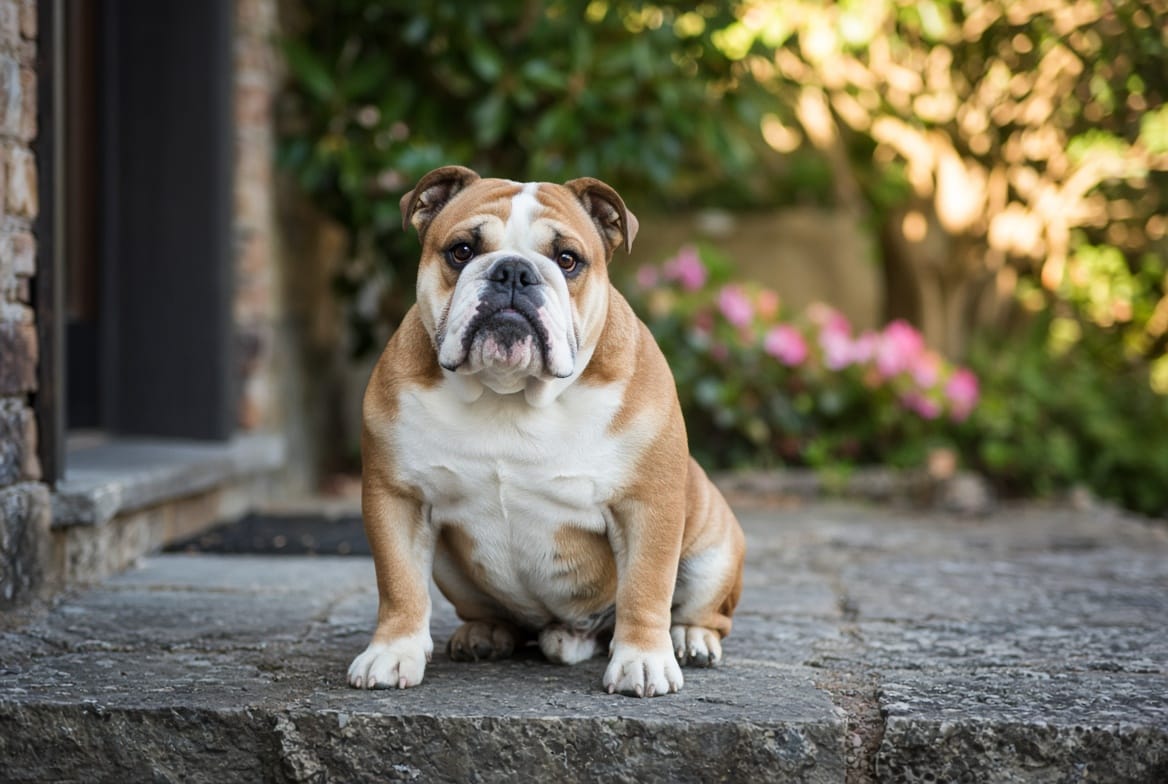
The Bulldog was created in medieval England for bull-baiting, and its ancestors were selected for huge jaws and a high pain threshold. When England banned blood sports in 1835 the breed lost its job and nearly died out, so admirers spent decades reworking it into a companion, refining its contours and breeding away the aggression. That reshaping came at a documented cost: a study of 2,662 English Bulldogs found 2.04 times the odds of being diagnosed with at least one disorder compared with other dogs, with raised odds for 24 of 43 specific disorders, and its authors called for immediate redefinition of the breed toward a moderate conformation. A separate survey of 102 breeding Bulldogs found one paternal haplotype in 93% of dogs. None of this makes the Bulldog a bad dog, and it is genuinely docile and fond of children, but it is a dog that will need active medical management.
Quick Facts
Native Range
Breed origin: England (bred for bull-baiting from the 13th century, then reworked into a companion after Britain's 1835 blood-sports ban)
Natural Habitat
Fully domesticated
Adult Size
14-15 inches at shoulder; about 50 lbs male, 40 lbs female
Wild Diet
Fully domesticated
Wild Lifespan
8-10 years (UK life-table data gives 7.39 years at birth against 11.23 for dogs overall)
Conservation Status
Not applicable (domesticated breed)
History
The rescue effort produced the first written breed standard for any dog. In 1865 Samuel Wickens published a set of points for the Bulldog under the pen name Philo-Kuon, a template meant to steer the animal toward the parlor. A second group formed The Bulldog Club in March 1875, issued its own standard that May, held the first Bulldog-only show the same year, and incorporated in 1894, making it the oldest single-breed kennel club in the world. The last recorded bull baiting in England took place in 1837, so the men writing those standards were describing a dog whose job had been gone for a generation.
Compare
Bulldog
Human
Adult Size
14-15 inches at shoulder; about 50 lbs male, 40 lbs female
5-6 feet (150-185 cm); ~135-200 lbs
Wild Lifespan
8-10 years (UK life-table data gives 7.39 years at birth against 11.23 for dogs overall)
~73 years (global average)
Wild Diet
Fully domesticated
Omnivorous - eats just about anything
Native Range
Breed origin: England (bred for bull-baiting from the 13th century, then reworked into a companion after Britain's 1835 blood-sports ban)
Global - originated in Africa roughly 300,000 years ago
Natural Habitat
Fully domesticated
Everywhere from arctic tundra to tropical megacities
Conservation Status
Not applicable (domesticated breed)
Least Concern (8+ billion and counting)
Test Yourself
What's the Bulldog's native range?
Fun Facts
🐶 Three Eyelids
Dogs have three eyelids. A third one called a nictitating membrane helps protect and moisten the eye. You can sometimes spot it when a dog is sleepy!
🐶 Unique Nose Prints
A dog's nose print is as unique as a human fingerprint. No two are alike! Some kennel clubs have started using nose prints for identification.
🐶 Dogs Dream Too
Dogs dream just like humans do. Their REM sleep looks remarkably similar to ours. You'll notice twitching paws and little whimpers as they relive their day.
🐶 Born Blind and Deaf
Puppies are born completely blind and deaf. They rely entirely on smell and touch for their first two weeks of life. Their eyes and ears open around 2 weeks old.
🐶 Mental Fatigue is Real
Regular mental stimulation is just as tiring for dogs as physical exercise. Puzzle feeders and training sessions work wonders for a calmer, happier pup.
🐶 A Nose Built Different
A dog's sense of smell is estimated to be 10,000 to 100,000 times more sensitive than a human's. Their wet nose actually helps by trapping scent chemicals so they can be analyzed more effectively.
Legal Guide
Subscribe - it's free
New animal facts and care guides straight to your inbox. No spam.
Health and More
🐕 Dog Enrichment: Let Them Sniff, and the Dog Gets More Optimistic
🐕 French Bulldog Enrichment: Build the Whole Plan Around the Airway
🧬 What a Pet DNA Test Actually Tells You
👁️ Inherited Eye Disease: What Screening Actually Catches
🦴 Hip and Elbow Dysplasia: What the Grades Actually Mean
🐽 BOAS: What Flat-Faced Breathing Actually Costs
Did You Know?
The Bulldog we know is a deliberate reconstruction. When Britain banned blood sports in 1835 the breed lost its job and nearly disappeared, and admirers spent the following decades reworking it into a companion, breeding away the aggression and reshaping the body. A survey of 102 breeding Bulldogs later found a single paternal haplotype in 93% of them, a measure of how narrow the pool doing that rebuilding was.
Explore More