Printable owner manual
A long-lived cockatiel starts with the food bowl and a night light.
A 52-page printable manual with the cage and the bar spacing that is a safety limit, the night light that stops a night fright from becoming an injury, two schedules for converting a seed eater, the levers that prevent chronic egg laying, seven health pages, and the printable owner tools.
Not sure yet? Download the first 5 pages free, contents page included.
- 52 pages, print or view
- Beginner friendly
- No external links inside the PDF
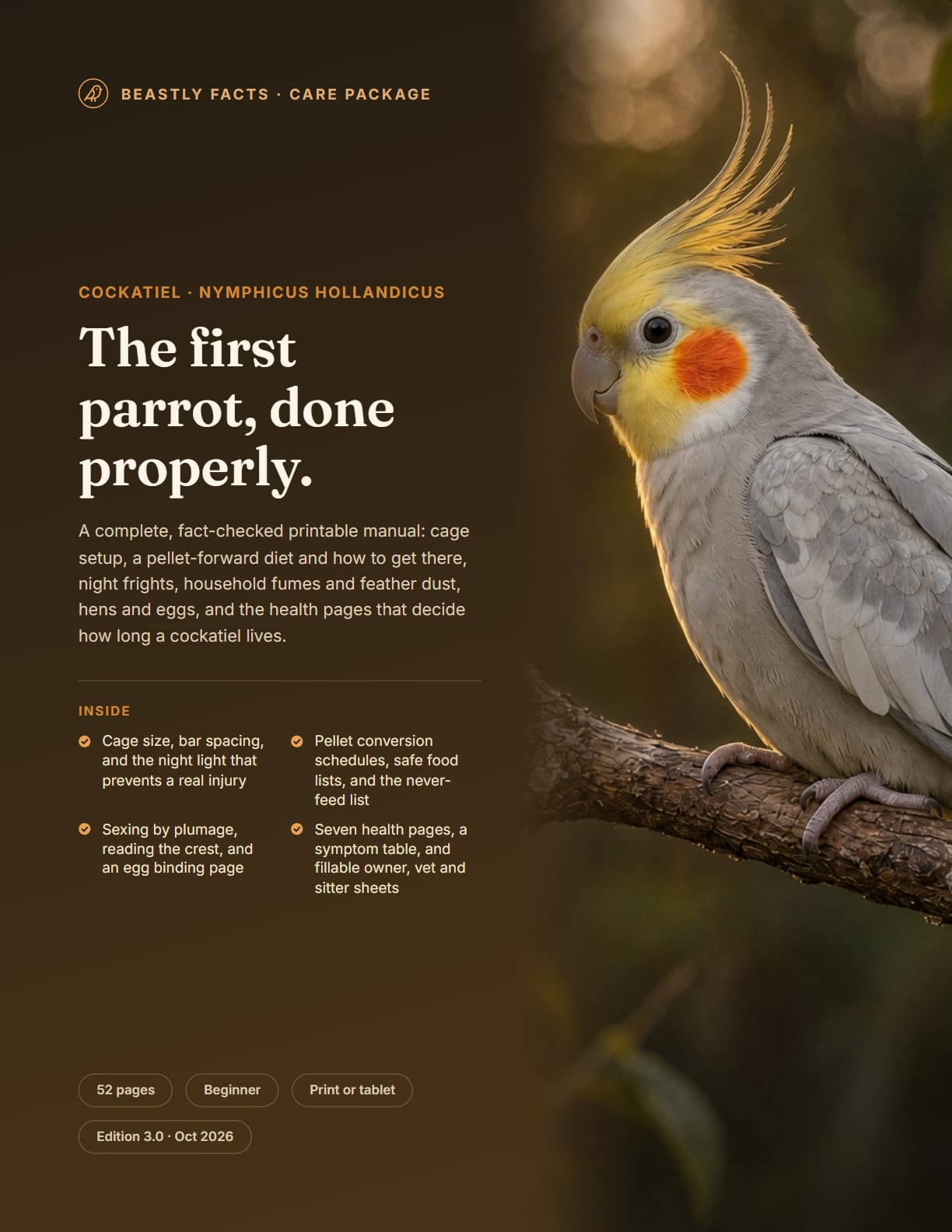
Edition 3.0
Oct 2026 · 52 pages
Care-sheet roulette
- A seed bowl sold as a complete diet
- A tall, narrow cage bought for its looks
- A bird thrashing in the dark at 2am, and nobody saying why
- A hen laying clutch after clutch with no male in the house
This guide
- 75 to 80 percent pellets, two schedules for converting a seed eater, and the weight loss that means slow down
- A 20 by 20 by 30 inch minimum, 24 by 24 by 30 for easier movement, width over height, and bars half an inch apart or closer
- Night frights explained, and the small night light that prevents the injury this species is known for
- The trigger list for chronic laying, why the eggs stay where they are, and egg binding as a same-day emergency
What's inside · 52 pages
Everything from first setup to daily routine.
Cage, placement and hazards
Cage size and the half-inch bar spacing, perches and dishes, where the cage goes, fumes from overheated nonstick pans (PTFE, polytetrafluoroethylene) and feather dust, metals, pets and plants, and cleaning.
Sleep and night frights
10 to 12 hours of real darkness, the small night light that prevents the signature injury, and day length as the hormone lever.
Diet and pellet conversion
The 75 to 80 percent pellet target, two conversion schedules and the daily weight check, vegetables, fruit and fresh food, treats, supplements and the never-feed list.
Handling and the crest
Taming in steps, reading the crest, one cockatiel or two, wing clipping on both wings, blood feather first aid, choosing a cockatiel, quarantine, sexing, and the daily gram scale.
Health and red flags
Chronic egg laying and egg binding, vitamin A, calcium and fatty liver, breathing problems and psittacosis, beak and feather disease and polyomavirus, Giardia, gastric yeast, rope and metal, plucking, and reading droppings.
Owner tools
Setup checklist, emergency card, budget and shopping list, first 30 days, symptom reference, routine, outage, heat and travel plan, pet-sitter sheet, and the logs.
Every page, section by sectionThe package's own contents page, all 52 pages of it. Nothing here is a teaser for something sold separately.
Getting Started
- How to Use This Package
Profile
- Quick Profile & Cost Overview
- The Species, Colors, Size & Lifespan
Housing & Environment
- Cage Size, Bar Spacing & Placement
- Perches, Dishes & What to Leave Out
- Temperature, Light, Sleep & Night Frights
- Air Quality: Fumes & Feather Dust
- Metals, Pets, Plants & Everyday Traps
- Cleaning & Hygiene
Feeding
- Diet: Pellets, Seed & How Much
- Converting a Seed Eater to Pellets
- Vegetables, Fruit & Fresh Food
- Treats, Supplements & the Never-Feed List
- Weight, Body Condition & the Daily Scale
Handling & Behavior
- Handling & Taming
- One Cockatiel or Two
- Body Language & Reading the Crest
- Enrichment & Common Mistakes
- Flight & Wing Clipping
- Nails, Beak, Blood Feathers & First Aid
Arrival & Life Stages
- Choosing a Cockatiel
- Quarantine & the First Vet Visit
- Sexing by Plumage & the Color Exceptions
- Hens, Hormones & Chronic Egg Laying
- Egg Binding
- Molt & Seasonal Changes
Health & Common Issues
- Red Flags & Finding a Vet
- Vitamin A, Calcium, Obesity & Fatty Liver
- Breathing Problems & Psittacosis
- Beak and Feather Disease & Polyomavirus
- Giardia, Gastric Yeast, Rope & Metal
- Feather Plucking & Feather Loss
- Reading Droppings & Water
Quick Reference
- Setup Checklist & Targets
- Emergency & Quick Targets Card
Owner Tools
- Budget: Setup & Shopping List
- Budget: Ongoing Costs & the Vet
- First 30 Days
- Symptom Quick Reference
- Daily, Weekly & Seasonal Routine
- Power Outages, Heat, Travel & Transport
- Pet-Sitter Sheet
- Owner Log
- Equipment & Vet Log
- Enrichment Checklist & Log
Reference
- Glossary, A to L
- Glossary, M to Z
- Sources
- Where the Sources Disagree
- Version History & About
Take a look inside
The pages that decide how long a cockatiel lives.
Click a page to see it at full size. The contents page is complete; the others fade out where the paid content starts.
The first 5 pages, free
Pages 1 to 5 as a PDF: the contents page and the opening pages before the care sections start, so you can see every page the full package covers.
Who this is for
- New cockatiel owners buying the cage before the bird
- Keepers with a bird on a seed mix who want it on pellets without a hunger strike
- Anyone with a hen who has started laying, before it turns into a habit
What it's not
- Not a substitute for an avian veterinarian
- Not a live website mirror, a clean printable package instead
- Not a subscription, one purchase and every corrected edition is free
What changed
This is edition 3.0.
Bought before? Re-download free from your library.
- 3.0, Oct 2026. Rebuilt on the current outline, 52 pages. Safety: perches 5/8 to 1.5 in (1.6 to 3.8 cm); a sick or egg-bound bird kept at 75 to 80°F (24 to 27°C); cage minimum 20×20×30 in, 24×24×30 in for easier movement, vertical bars; a seed-fed bird gets 1.5 to 2 level teaspoons a day; pellet conversion: never more than 12 hours without food, slow down at 1 to 2% weight loss in a week, call the vet at 10%; a completed clutch stays the full 19 to 21 days; bleach at 1 part to 32 parts water; medicine doses removed. Costs: every item priced and rounded to the nearest $5; setup $370 to $765 with the bird; $180 to $360 a year ($15 to $30 a month) plus vet exams. Other changes are wording only.
- 1.3, Oct 2026. Outside sources named in the care text rewritten as plain statements. Other changes are wording only. Replaced by 3.0.
- 1.2, Oct 2026. Safety: daily bath and weigh-in (1 to 2% weekly limit in a diet change); two cocks, not two hens, as the no-egg pairing; quarantine 30 to 45 days, up to 90 for an established flock; an hour or more out of the cage daily; sick-bird warmth 80°F; the 24-hour droppings rule. Costs: upkeep $200 to $350 a year before the exam. Replaced by 1.3.
- 1.1, Sep 2026. Safety: a broken blood feather gets firm pressure, never pulled at home; egg-binding warmth 80 to 85°F; multi-bird quarantine 90 days; no fixed interval for wing feather regrowth. Replaced by 1.2.
- 1.0, Sep 2026. First edition. Replaced by 1.1.
Ready when you are
Cockatiel Care Package
52 pages. PDF. Print it or keep it open on your phone, tablet, or computer. Yours the moment you check out.
Edition 3.0, published October 3, 2026. Paid through Stripe. The download link arrives on the next page, and it stays in your library for as long as the package exists, always as the current edition. Not a substitute for a vet.
More care packages
Same format, other animals.
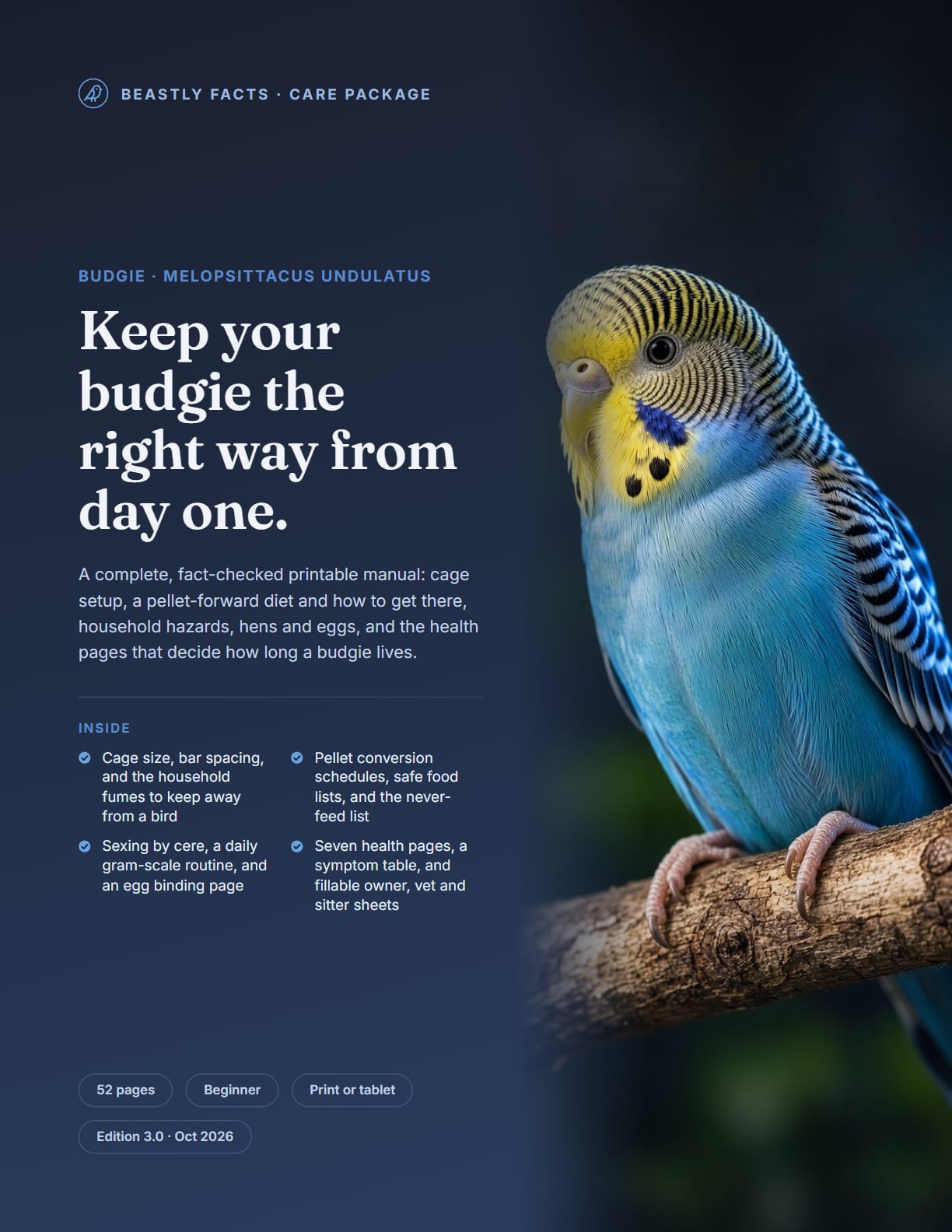
Budgie Care Package
"Easy first bird" isn't the same as easy cage.
52 pages · PDF · edition 3.0
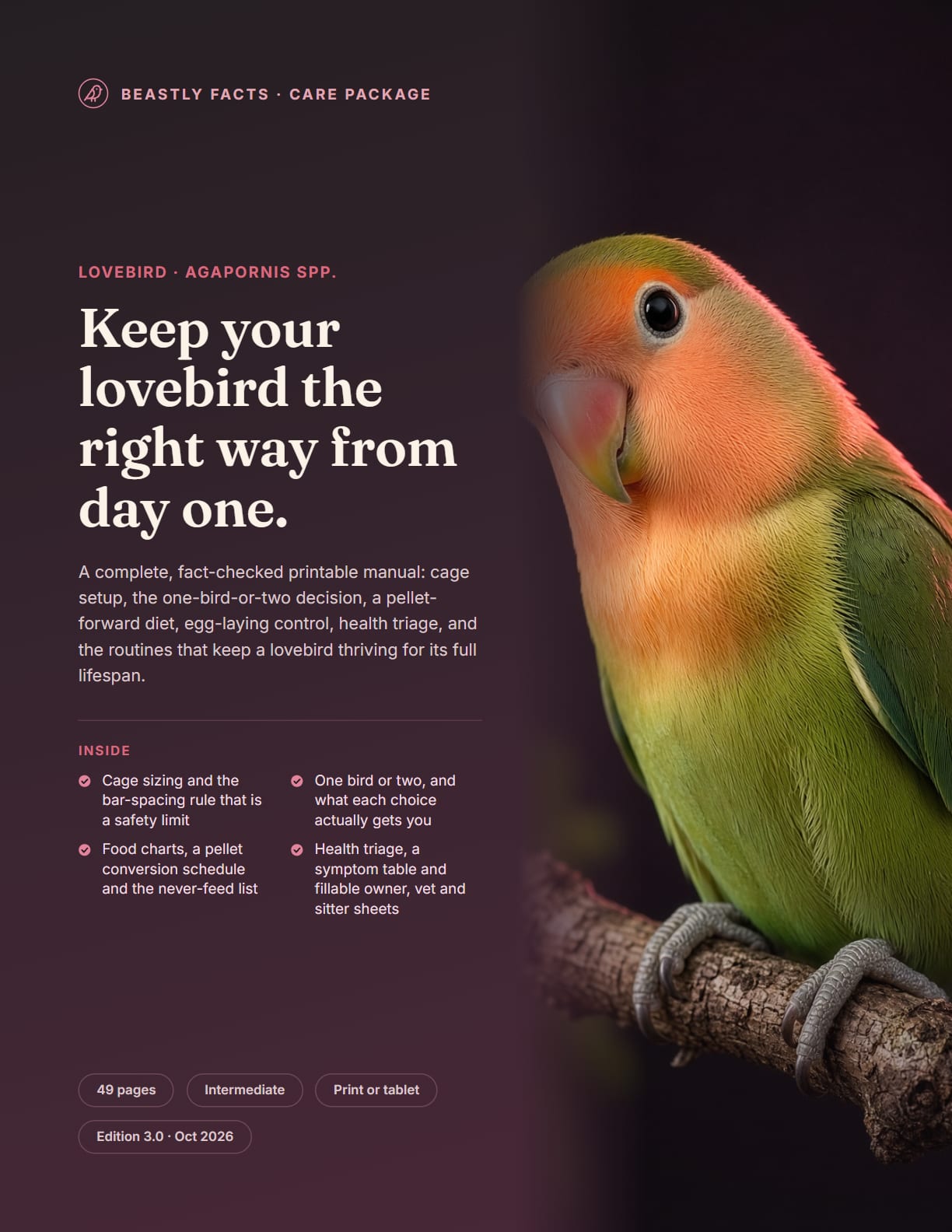
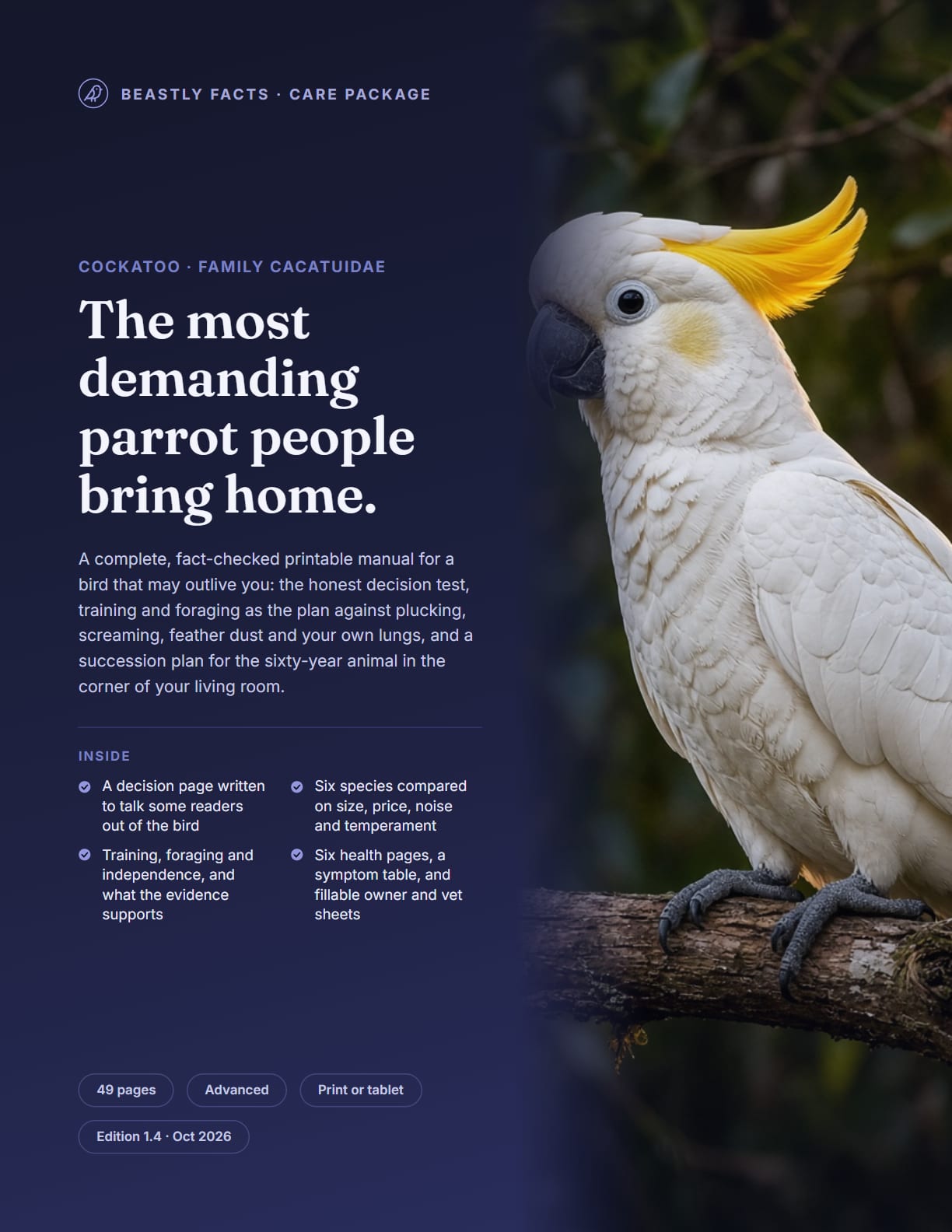
Cockatoo Care Package
Four to six hours most days, for decades. Take the honest test first.
49 pages · PDF · edition 1.4
The free cockatiel guide is still free
This package is the same research as our cockatiel care guide, reformatted into an offline manual with the checklists, logs, and triage tables the web pages do not carry. Read the free guide first and buy this only if you want it in your hands.