Cockatoo
Birds
The feathered drama major that loves you loudly and forever!
Mike has looked after a neighbor’s cockatoo on and off for years.
On This Page▾
Did you know? Cockatoos are considered the most affection-dependent parrots in aviculture. In the wild they maintain near-constant physical contact with their flock and mate, and a captive cockatoo often expects the same level of contact from its owner - which is exactly why the species has one of the highest rates of severe feather-plucking and behavioral problems of any commonly kept parrot when that need isn't met.

The first week
The numbers a new owner needs in the first week, each from the article it links to. Rows with no link come from the encyclopedia.
- Day one
- At least 30 days, and up to 45, quarantined in a separate room with its own airspace, away from any bird you already own. A multi-bird household or aviary is safer nearer 90 days.Quarantine guide →
- Enclosure
- 36 inches wide by 24 inches deep by 48 inches tall is a commonly cited minimum, with many avian vets recommending closer to 48 by 48 by 60 inches as a genuinely comfortable size. Bigger is always better with this species.Setup guide →
- Bar spacing
- Three-quarters of an inch to 1 inch for large cockatoos. Secure, genuinely escape-proof locks matter more here than with most birds, cockatoos are notorious escape artists with the intelligence and strength to work out standard latches.Setup guide →
- Cage material
- Stainless steel is the gold standard, rust-proof and able to withstand a beak this powerful for decades. Heavy-gauge powder-coated steel is an acceptable, more affordable alternative. Avoid galvanized or zinc-coated cages entirely, a bird that chews the bars risks metal toxicity from that coating.Setup guide →
- Sleep
- 10 to 12 hours of genuine darkness and quiet for sleep every night. Sleep deprivation in this species measurably worsens screaming and other behavioral issues.Setup guide →
- Diet
- Pellets should make up 75 to 80% of daily intake, fresh vegetables most of the remaining 20 to 25%, fruit a smaller share, and seeds under about 10%, kept to high-fat treats rather than the foundation.Feeding guide →
- Bonding
- Avoid over-bonding in the first weeks, it cements an anxious dependency rather than a healthy one. Real engagement with this species means 4 to 6 hours of interaction most days, not an occasional check-in, but consistent shoulder and lap time can itself become the problem if a cockatoo forms a pair bond with one person.Handling guide →
- Budget
- $700 to $3,000 for common species (rarer species run higher). The equipment and first supplies come to $1,430 to $3,200, every item priced from the cage to the first bag of pellets, so $2,270 to $6,410 sets you up with the bird and a first exam, and $875 to $1,995 a year after that. Toy replacement is the biggest recurring line, since cockatoos destroy wooden toys fast.Cost guide →
- Adult size
- 12 to 27 inches (31 to 70 cm) and roughly 300 to 900 g (10 to 30 oz) across the species, Goffin's and galahs at the light end, Moluccans at the heavy end.
- Lifespan
- 25 to 45 years is typical, and the larger species can reach 70 to 80 or more.Cost guide →
- Disease risk
- Psittacine beak and feather disease is incurable, often fatal, and highly contagious. Confirm with a vet through PCR testing, and quarantine any new bird before it meets an established one.Health guide →
- Power outage
- Keep feeding and watering through an outage rather than pulling food the way you would for a reptile; a bird carries far less fat reserve than its size suggests. The real danger is combustion, not cold: no candles, gas heat, or a generator run anywhere near the bird's room.Emergency plan →
Emergency card
Call the vet now if you see any of these.
- Over-preening to bare skin, or in serious cases, self-mutilation
- Abnormal or clubbed feathers, or a beak that looks glossy from lost powder-down
- Beak deformity
- A sudden change in a previously stable bird's vocal or behavioral pattern
- An enlarged liver, or changes in beak or nail keratin
An avian vet, found before you need one. Always start with a vet visit to rule out a medical cause before assuming plucking or screaming is purely behavioral, and confirm PBFD with a vet through PCR testing.
Where to go next
How Much Does a Cockatoo Really Cost?
$700 to $3,000 for the bird, $2,270 to $6,410 fully set up with it, $875 to $1,995 a year, and the lifespan number that should drive the whole decision.
How to Handle a Cockatoo (And Why They're So Often Surrendered)
Why cockatoos get surrendered so often, the over-bonding trap, and the 4 to 6 hour daily reality.
Common Cockatoo Health Issues and What Causes Them
Feather-destructive behavior, PBFD, lipomas, fatty liver disease, and when a behavior change means the vet.
Cockatoo Cage Setup: Size, Material, and Daily Enrichment That Actually Matters
The 36x24x48 minimum, stainless steel versus powder-coated, bar spacing, and sleep.
Why Cockatoos Scream and Pluck: The Behavior Behind the Headlines
The research behind why cockatoos scream and pluck, and what actually helps versus what doesn't.
Cockatoo Feeding: Schedule, Diet, and the Ratio Worth Memorizing
The 75 to 80% pellet ratio, the toxic food list, and the mistakes that lead to fatty liver disease.
Cockatoo Enrichment: What the Research Actually Supports
What the research actually supports, foraging to fill the gap a bowl leaves, and destruction done deliberately.
Is It Legal to Own a Cockatoo? State-by-State Guide
State by state, including the states that treat an endangered species as off-limits regardless of a permit.
What to buy
Underlined items are paid Amazon links. We may earn a commission at no extra cost to you.
Prices and the reasoning behind each item are in How Much Does a Cockatoo Really Cost?.
Full Cockatoo gear listFrequently Asked Questions
How much does a cockatoo cost to buy?
$700 to $3,000 for common species like Goffin's, Galah, and Umbrella cockatoos, with Umbrella cockatoos commonly running $1,000 to $3,000. Moluccan cockatoos typically run $1,400 to $3,500, and rarer species like the palm cockatoo can reach $2,000 to $16,000 or more.
What size cage does a cockatoo need?
36 by 24 by 48 inches is the commonly cited minimum, and many avian vets recommend closer to 48 by 48 by 60 as a comfortable size. Bigger is always better with this species.
Why are cockatoos so often surrendered?
The demands outrun what most owners signed up for. One parrot behavior consultant reports that cockatoos are among the most consistently relinquished parrots, and that over half her clients own one. Rescue organizations describe the same pattern.
Encyclopedia
Cockatoo
Cacatua alba
Subscribe - it's free
New care guides straight to your inbox. No spam.
Printable Guide
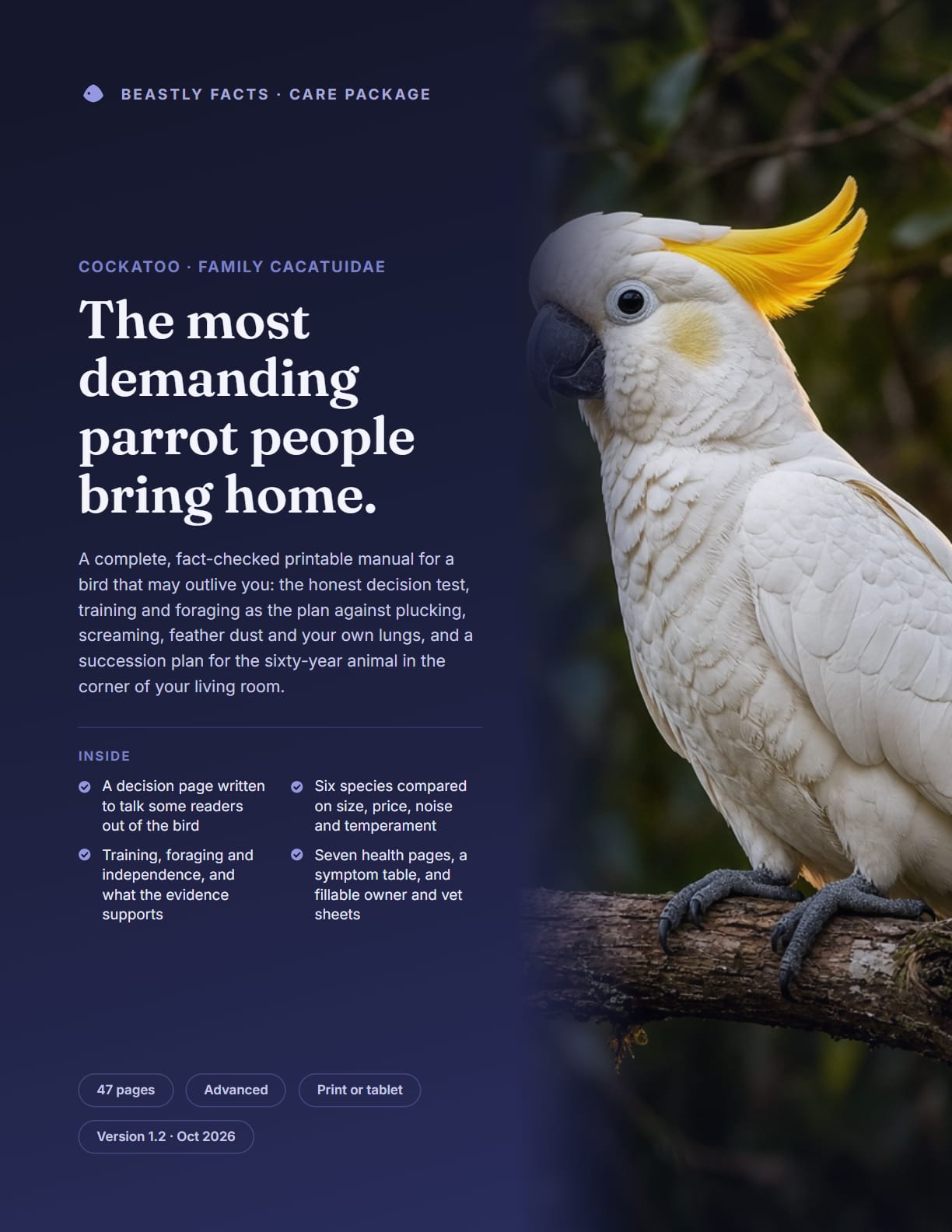
Cockatoo Care Package
49 pages · PDF · $8.99
Legal Guide
Deep Dive
🦜 How Much Does a Cockatoo Really Cost?
🦜 How to Handle a Cockatoo (And Why They're So Often Surrendered)
🦜 Common Cockatoo Health Issues and What Causes Them
🦜 Cockatoo Cage Setup: Size, Material, and Daily Enrichment That Actually Matters
🦜 Cockatoo Feeding: Schedule, Diet, and the Ratio Worth Memorizing
🦜 Cockatoo Enrichment: What the Research Actually Supports
Health and More
⚠️ Household Hazards for Pet Birds: The Complete Safety Checklist
🚪 Quarantining a New Bird: The Real Timeline and Why It Matters
💩 Reading Bird Droppings: The Daily Health Check Every Owner Should Know
🌙 Photoperiod and Sleep: The Light Schedule That Controls Your Bird's Hormones
🦜 Converting a Seed-Eating Bird to Pellets Without Starving It
✂️ Wing Clipping: Flighted vs. Clipped, Both Sides Explained
🔦 Bird Emergency Plan: Power Outages, Travel, and Transport
⚖️ Sexing, Weight, and Body Condition in Pet Birds: What Actually Works
🥚 Chronic Egg Laying and Egg Binding in Budgies, Cockatiels, and Lovebirds
🪶 Why Is My Bird Losing Feathers? Molt vs. Plucking vs. PBFD vs. Giardia
🦜 Choosing a Pet Bird: What You're Actually Signing Up For
🦠 Avian Polyomavirus: Budgerigar Fledgling Disease and French Molt
🦜 Reading Bird Body Language: Fluffed Content vs. Fluffed Sick
🌫️ Feather Dust, Air Quality, and Bird Fancier's Lung
🎯 Parrot Training: The Behavior Ladder From Budgie to Macaw
🩹 Bird First Aid Kit and Grooming: Nails, Beak, and Blood Feathers
📋 Succession Planning for a Pet That May Outlive You
🕊️ Adopting a Rescue Parrot: The First Months, Honestly
⚠️ Four Pets, Four Things Nobody Mentions Before You Buy
🦜 Cockatiel vs. Cockatoo: Which Parrot Actually Fits Your Life
🦜 African Grey Parrot vs. Cockatoo: Which Big Parrot Commitment Fits You
🦅 The Ultimate Birdwatching Guide: Best Places, Times, and Tips for Beginners (2026)
Explore More