Cats Invented the Meow for Humans, and Barely Use It on Each Other
On This Page▾

Watch two cats who live together and have known each other for years. They rub faces, they groom, they sit back to back, they hiss when one is fed up. What they almost never do is meow at each other.
Point a cat at a human and the behavior switches on immediately. That asymmetry is not an accident of personality. It is the clearest surviving evidence of what domestication did to cats, and it runs deeper than most people expect.
Kittens Meow. Adult Cats Are Supposed to Stop
Meowing starts as infant equipment. A kitten separated from its mother, cold, or stuck somewhere produces a distress call, and the mother responds by retrieving it. It is a straightforward care-soliciting signal between a helpless animal and the one animal obliged to help.
In wild felids that behavior fades with weaning. An adult cat has no use for a call that means "come and take care of me", because no other adult cat is going to. Adult cat to adult cat communication runs mostly on scent marking, body posture, tail position, and a small set of close-range sounds. Meowing is not really part of it.
House cats never finish switching it off. They keep the kitten call into adulthood and aim it at the one species that reliably answers.
The Wildcat Comparison
The interesting test is not whether house cats meow. It is whether their meow sounds different from their wild ancestor's.
Domestic cats descend from the African wildcat, Felis silvestris lybica. Nicholas Nicastro compared vocalizations from both and found they are not the same signal. Wildcat calls are longer, lower pitched, and harsher. Domestic cat meows are shorter and higher, and when human listeners rated recordings for pleasantness, they consistently scored the house cat versions as more pleasant and less demanding, without knowing which was which.
That is the shape of a signal that has been selected on. Over thousands of years of living alongside people, cats whose calls humans found tolerable and worth responding to did better than cats whose calls people found grating. The meow did not merely persist into adulthood. It was reshaped by the audience.
Your Cat Has a Version for You Specifically
There is a second layer, and it is the part most owners have noticed without having a name for it.
Cat meows are not a shared vocabulary. There is no universal cat sound meaning "food" that any cat would produce and any human could decode. What develops instead is a private one, negotiated between one cat and one household over time.
Nicastro and Owren tested this by playing recordings to listeners and asking them to identify what the cat wanted. People did better than chance with their own cat and noticeably worse with cats they did not know. Cat owners in general outperformed non-owners, so some of it is learned skill at reading cats. But a meaningful share of the accuracy was specific to that cat, that person, and the history between them.
Your cat worked out which noises get results in your house and kept the ones that worked. A different household would have converged on something else.
The Purr Has a Trick In It
The related signal is the purr, and it is stranger than it looks.
Purring runs roughly 25 to 150 Hz and is not exclusively a contentment sound. Cats purr while nursing, while being handled at the vet, while injured, and sometimes while dying. Whatever it is for, "I am happy" does not cover the range.
Karen McComb's team identified a variant they called the solicitation purr, produced by cats actively trying to get something, usually food. Acoustic analysis found an unusually high frequency component embedded inside the normal low purr, sitting in roughly the same range as a human infant cry. Played to listeners, these purrs were rated as more urgent and less pleasant than ordinary purring, again without listeners knowing which was which.
A cat asking for breakfast has effectively smuggled a baby cry into a sound humans are predisposed to find soothing. It is difficult to ignore, which is presumably the point.
Meowing is a kitten behavior that house cats never grew out of, aimed at the species that answers it. Cat to cat communication runs on scent and body language instead, which is why a cat can live with another cat for a decade and rarely meow at it once.
What This Means If You Live With One
A few practical consequences fall out of this.
A cat that suddenly meows a great deal more than usual is worth paying attention to. Because the signal is aimed at you rather than at other cats, a change in it is a change in what the cat is trying to tell you. Sharp increases in vocalization show up with hyperthyroidism, with pain, with hearing loss, and with cognitive decline in older cats.
It is also worth knowing that you trained the current system, whether or not you meant to. If meowing at 5 am has ever produced food, the cat has correctly learned that meowing at 5 am produces food. The vocabulary is negotiated, and both parties are negotiating.
And the affection is not imaginary. A cat that meows at you is doing something it does not do to other cats. It has categorized you as the thing that responds, which is not the worst description of what a relationship is.
Sources
- Nicastro, N. (2004). Perceptual and acoustic evidence for species-level differences in meow vocalizations by domestic cats and African wild cats. Journal of Comparative Psychology.
- Nicastro, N. and Owren, M. J. (2003). Classification of domestic cat vocalizations by naive and experienced human listeners. Journal of Comparative Psychology.
- McComb, K., Taylor, A. M., Wilson, C. and Charlton, B. D. (2009). The cry embedded within the purr. Current Biology.
- Bradshaw, J. W. S. (2013). Cat Sense: How the New Feline Science Can Make You a Better Friend to Your Pet.
That a small cat evolved a whole vocalisation aimed at us is easier to appreciate next to the wild ones, where lions are the only cat that lives socially at all and the other thirty-nine species have nobody to talk to.
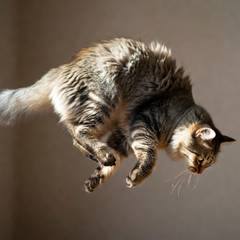
The meow took thousands of years of domestication to reshape. The righting reflex that lets a cat always land on its feet needed no domestication at all. It predates the relationship with us by a wide margin.

Written by Michael Ryan
Mike keeps two rescued bearded dragons, Dex and Cera, and writes the care guides on BeastlyFacts from his own research and mistakes. He is not a veterinarian.
More about Michael Ryan →Comments
No comments yet - be the first!