Beagle Enrichment: The Study That Explains the Whole Breed
On This Page▾

Most breed enrichment guides borrow a finding and stretch it. This one gets to use the closest thing dog enrichment has to a headline result on the breed it fits best.
Dogs given nosework became measurably more optimistic on a cognitive bias test; dogs given heelwork did not change. The authors attributed it to expressing a natural behavior autonomously. A beagle is a dog selected for exactly that, over centuries, and the practical upshot is that scent work is not an activity you add. It is the plan.
What the Nosework Study Found
Duranton and Horowitz, Applied Animal Behaviour Science, 2019, covered in full in our dog enrichment guide.
Twenty pet dogs, ten doing nosework where they could sniff and search, ten doing heelwork where they could not. A cognitive bias test measured latency to approach an ambiguous bowl placed between a location that always held food and one that never did.
The nosework group's latency declined significantly. The control group's did not change. Both got the same amount of structured time with a person. What differed was whether the dog got to use its nose and choose its own route.
For most breeds that is a useful finding. For a scent hound it is a description of the animal.
Beagles are the breed used most often in laboratory research, largely because they are small, docile and tolerant. The same literature that made them the default research dog also produced a great deal of what is known about enriching kenneled dogs, which is a genuinely uncomfortable thing to sit with.
Everything that applies to dogs generally, beagle or not, is in that dog enrichment guide.
Scent Work, as the Main Course
Not a supplement. Daily.
Start with food scattered in grass and build to hidden items, a search cue, and tracking a trail you have laid. A snuffle mat is the indoor five minute version, and a puzzle toy adds a manipulation problem on top.
On walks, let the dog track. A beagle walked at heel past everything interesting is a beagle doing the control condition of that study. A walk where it gets to follow its nose is worth more than a longer one where it does not.
Formal scent work classes suit this breed better than almost any other, and they give the whole thing a structure.
Recall, Realistically
Say it plainly: plan for a beagle that will not reliably recall off a live scent. That is not a training failure, it is what the breed was selected to do, and pretending otherwise is how beagles get lost and hit by cars.
A long line, secure fenced fields, and a solid emergency stop rather than a hopeful recall. Give the off-lead freedom in places where the failure mode is not catastrophic.
Food Motivation, Put to Work
Beagles are strongly food motivated and among the most obesity-prone breeds in practice. Both facts point the same way.
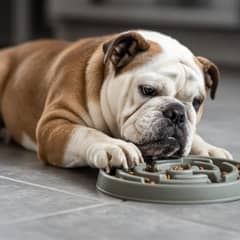
Move the daily ration into the enrichment: scatter feeding, scent games, puzzles, and a lick mat for a calm wind-down task. Take it out of the ration rather than adding it, and weigh the food.
Secure the bins and the counters. A beagle will find food you have forgotten about, and our guide to pet obesity and body condition covers what happens when it succeeds regularly.
Company
Pack hounds. They cope badly with long stretches alone, and the classic complaint profile, baying and destruction, is usually a beagle by itself in a garden with nothing to track.
Company, whether human or canine, plus a scent task before you leave, does more about that than any anti-bark measure.
The Voice
The baying was selected for. It is not going away, and a good deal of the excess is boredom and frustration.
Manage what is manageable: daily scent work, company, and not reinforcing the vocalizing with attention. Accept the rest, and factor it into whether a beagle suits your housing at all.
Physical Exercise
Needed, and less central here than for a working breed. Beagles are stamina hounds and enjoy distance, and a sniffing walk beats a brisk one. Our guide to why your dog needs daily exercise covers the baseline.
Priority Order
- Daily scent work, indoors and out
- Walks where the dog is allowed to track
- The whole daily ration delivered through scent and puzzle work
- Company, and no long stretches alone
- A long line and secure areas instead of optimistic recall
- Weighed food and secured bins
- Physical exercise, on sniffing walks
What Not to Do
Do not walk a scent hound at heel past everything and call it exercise. Do not trust off-lead recall near a live trail. Do not free-feed a breed this food-motivated. Do not add enrichment food on top of meals. Do not leave a pack hound alone all day and treat the baying as a training problem. And the inherited eye disease guide covers the health screening side before a scent hound starts serious trail work.
The dog enrichment guide has the routine that applies to every breed, and the pet obesity and body condition guide is how you check whether a food-motivated hound is paying for its enrichment in weight.
Sources & Further Reading
Last reviewed 14 Sep 2026 · 3 sources
- Duranton C and Horowitz A (2019). Let me sniff! Nosework induces positive judgment bias in pet dogs. Applied Animal Behaviour Science
- Let me sniff! Nosework induces positive judgment bias in pet dogs, full text PDF. Barnard College
- Finding hidden food in nosework increases dogs' optimism. Companion Animal Psychology
Frequently Asked Questions
Is there research relevant to beagle enrichment?
The nosework study by Duranton and Horowitz is the most directly relevant work in dog enrichment for any breed, and it lands hardest here. Dogs given scent work approached an ambiguous bowl significantly faster afterwards, the standard optimism measure, while dogs given heelwork did not change.
Why is that finding so relevant to beagles?
Because a beagle is a nose with a dog attached. The study's explanation is that scent work lets a dog express a natural behavior autonomously, and for a breed selected for centuries to follow a trail independently of a handler, that is the core of what the animal is for.
Will my beagle ever have reliable off-lead recall?
Plan as though not. Beagles were bred to follow a scent away from a handler for hours, and once a trail is picked up, recall competes with several centuries of selection. A long line and secure fenced areas are the realistic answer rather than a training failure.
Why is my beagle always hungry?
Beagles are strongly food motivated as a breed and are one of the most obesity-prone dogs in veterinary practice. That is a management problem and also an opportunity, since food motivation makes scent-and-food enrichment straightforward to set up.
Is the baying trainable?
Partially. The voice is what the breed was selected for, so it will not disappear, and much of the excess is boredom and frustration. A beagle with daily scent work and company bays less than one left alone in a garden.
Do beagles need company?
They are pack hounds and cope poorly with long isolation, more so than many breeds. A beagle left alone all day is the classic profile for both the vocalizing and the destruction people complain about.
More on the Beagle
Recommended Gear
As an Amazon Associate I earn from qualifying purchases through the links above, at no extra cost to you.

Written by Michael Ryan
Mike keeps two rescued bearded dragons, Dex and Cera, and writes the care guides on BeastlyFacts from his own research and mistakes. He is not a veterinarian.
More about Michael Ryan →