Why Bearded Dragons Need UVB Lighting (And Why Skipping It Is Deadly)
On This Page▾

A bearded dragon is a desert lizard that spends its day basking in full Australian sun, and its body is built around that light. UVB is the part of sunlight it cannot do without. Without it the dragon cannot make enough vitamin D3, without D3 it cannot absorb calcium from its food, and a growing dragon short of calcium starts pulling it out of its own skeleton. The disease that follows is slow, visible, and almost always preventable with one piece of equipment.
What UVB Does Inside a Bearded Dragon
UVB hitting the skin converts a precursor molecule into previtamin D3, which the body then turns into the circulating form of the vitamin and finally into the active hormone that lets the gut take up calcium. Calcium does more than build bone. It runs muscle contraction and nerve signaling, which is why a calcium-starved dragon twitches before it breaks.
The obvious question is whether a D3 supplement can stand in for the bulb. For bearded dragons that has been tested directly. A 2010 study raised 84 hatchling bearded dragons either on rising doses of oral vitamin D3 or under UVB for 2 to 12 hours a day. At six months, the dragons under UVB had blood levels of the main circulating form of vitamin D3 18 times higher than the supplemented dragons, and as little as 2 hours of UVB a day kept those levels adequate. Oral D3 could not bring the supplemented group anywhere near them. A dusting of D3 is a backup, never the plan.
Metabolic Bone Disease
The veterinary name for what happens without UVB is nutritional secondary hyperparathyroidism. Keepers call it metabolic bone disease, or MBD. It comes from a diet short of calcium or vitamin D3, or from husbandry that denies the animal UVB or enough heat to digest, and it hits rapidly growing insect-eating and plant-eating lizards hardest. A juvenile bearded dragon is both.
The signs, roughly in the order a keeper notices them:
- Lower appetite and energy, and less time spent moving around the enclosure
- Trouble walking, or a dragon that no longer lifts its body clear of the floor
- Twitching toes and muscles, which can progress to full tetany
- A swollen or rubbery lower jaw, and a distorted upper jaw
- Swollen long bones in the legs, and fractures in the limbs or spine from minor falls
- Cloacal prolapse
Caught while the dragon is still eating, the outlook is good. Treatment means correcting the diet and the lighting first, plus fluids, feeding support and injectable calcium in a dragon that is already in crisis. What treatment does not do is straighten a jaw or a limb that has already healed crooked, so a dragon that recovers from severe MBD usually carries its shape for life. The same disease is behind most of the lizard and tortoise cases in the complete UVB lighting guide, where the Ferguson zone system for matching light strength to species is laid out.
The Setup Numbers
| Setting | Target for a bearded dragon |
|---|---|
| Lamp type | A linear T5 high-output tube with a reflector, spanning about two-thirds of the enclosure |
| UV index at the basking spot | 4.0 to 4.5, measured with a Solarmeter 6.5, falling to near zero in the shade |
| Hypomelanistic, translucent and similar morphs | No more than 3.0 at the basking spot |
| Distance, lamp to dragon | About 16 to 18 inches above the basking spot with nothing in between, about 11 to 12 inches through mesh, for a 12% tube |
| Replacement | Every 6 to 12 months depending on the model, even while it still glows. Arcadia rates its T5 HO and T8 Desert tubes at 12 months |
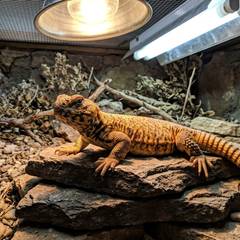
The lamp mounts inside the enclosure or over a mesh top. Glass and most plastics block UVB, so a lamp shining through a glass lid, and a dragon sitting by a sunny window, both get close to none. A mesh screen passes some UVB and filters the rest, which is why the distance for the same tube runs about 11 to 12 inches with mesh in the way and 16 to 18 inches without it. The tube-versus-compact-bulb question comes up with every new setup, and the answer for a basking desert lizard sits in the T5 versus compact UVB comparison.
UVB output fades long before the visible light does, so a tube that looks as bright as the day it went in can be doing very little. Write the install date on the fixture and replace it on the rated life, not on appearance. A UV meter settles the question for anyone who wants to check rather than trust the calendar.
The gradient matters as much as the peak. A bearded dragon regulates its own exposure by moving between the basking spot and the shade, the way it would move between sun and cover in the wild, so the tube should cover the basking end and part of the middle while the cool end stays dim. A dragon given only one strength of light everywhere has lost the choice.
That trial fed some hatchlings up to four times the standard vitamin D3 dose. None of the supplemented groups came close to the vitamin D levels that 2 hours of UVB a day produced. The skin did what the supplement could not.
Why It Matters Most in the First Year
A juvenile bearded dragon grows fast, and every gram of new bone is built from calcium it can only absorb with D3. That is why MBD hits growing dragons hardest, and why the lighting is the one part of a bearded dragon setup where the cheaper option costs the most later. A dragon that spends its first year under a proper tube, at the right distance, replaced on time, has the calcium it needs to build a straight skeleton.
Sources
5 sources
- Oonincx DGAB, Stevens Y, van den Borne JJGC, van Leeuwen JPTM, Hendriks WH (2010). Effects of vitamin D3 supplementation and UVb exposure on the growth and plasma concentration of vitamin D3 metabolites in juvenile bearded dragons (Pogona vitticeps). Comparative Biochemistry and Physiology Part B 156:122-128.
- Merck Veterinary Manual: Nutritional, Metabolic and Endocrine Diseases of Reptiles
- UVB Lighting for Reptiles: Tree of Life Exotic Pet Medical Center
- ReptiFiles: Bearded Dragon Temperatures and UVB Requirements
- Arcadia D3+ Desert lamp specifications: Arcadia Reptile
Frequently Asked Questions
Do bearded dragons need UVB?
Yes. UVB on the skin makes vitamin D3, D3 lets the gut absorb calcium, and without it a growing dragon pulls calcium from its own skeleton. In a 2010 study, hatchlings under UVB had 18 times the circulating vitamin D3 of orally supplemented dragons.
Can I use a D3 supplement instead of a UVB bulb?
No. In that trial, even four times the standard oral D3 dose came nowhere near the levels that 2 hours of UVB a day produced. A dusting of D3 is a backup, never the plan.
How far should the UVB tube be from a bearded dragon?
For a 12% T5 HO tube, about 16 to 18 inches above the basking spot with nothing in between and about 11 to 12 inches through mesh, aiming for a UV index of 4.0 to 4.5 at the basking spot and no more than 3.0 for hypomelanistic, translucent and similar morphs.
How often should I replace a UVB bulb?
Every 6 to 12 months depending on the model, even while it still glows, because UVB output fades long before the visible light does. Arcadia rates its T5 HO and T8 Desert tubes at 12 months. Write the install date on the fixture, or check with a UV meter.
Written by Michael Ryan
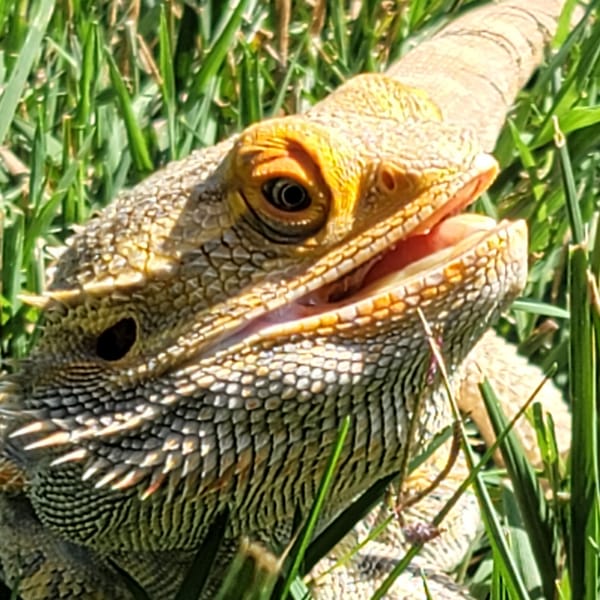
Written from Mike’s own two dragons, Dex and Cera.
Mike keeps two rescued bearded dragons, Dex and Cera, and writes the care guides on BeastlyFacts from his own research and mistakes. He is not a veterinarian.
More about Michael Ryan →