Constriction Does Not Crush or Suffocate, and the Green Anaconda Is Not the Longest Snake
On This Page▾

The standard description of how a constrictor kills has two versions, and both are wrong.
The first is that the snake crushes its prey, breaking bones and flattening organs. The second, more common in careful sources, is that it suffocates: every time the animal breathes out the snake takes up the slack, the chest cannot expand again, and eventually the prey stops breathing. It is a patient, grim, slow-motion image, and it has been repeated in textbooks for decades.
In 2015 somebody finally put instruments inside the coils.
What the Measurements Showed
Scott Boback and colleagues published the result in the Journal of Experimental Biology. They anesthetized rats, fitted them with electrocardiogram electrodes and blood pressure catheters in a major artery and a major vein, and then let boa constrictors do what boa constrictors do, recording throughout.
The numbers are not subtle. Within six seconds of the coils closing, arterial blood pressure at the femoral artery had fallen to half its baseline. Over the same few seconds, central venous pressure rose roughly sixfold.
That combination is the whole story. Arterial pressure is what pushes blood out to the brain, heart and organs; venous pressure is what lets it return. Squeeze the whole body at once and you collapse the first while the second backs up. Circulation stops. The prey loses consciousness in seconds, and the heart fails shortly after.
Suffocation would take minutes. This does not.
Constriction is a circulatory attack, not a respiratory one. The snake is not waiting for its prey to run out of air. It is collapsing blood pressure so fast that the animal is unconscious in seconds, which is why the old slow-suffocation picture was not just imprecise but the wrong system entirely.
Why the Distinction Matters
It is tempting to file this under trivia, but it changes what the animal is doing.
A snake that suffocates its prey has to hold on for several minutes, out in the open, wrapped around something that is still struggling. That is dangerous and expensive. A snake that induces circulatory arrest is finished in well under a minute, which is a far better deal for an animal that has to survive whatever the prey does on the way down, and whatever else is watching.
It also explains a detail keepers have long noticed: constrictors tighten in response to the prey's heartbeat, not just its breathing. If circulation is the target, that is exactly the feedback you would expect the snake to be reading.
One honest caveat. The measurements were taken with boa constrictors, because you can work safely with a boa in a lab. The mechanism is expected to hold across constricting snakes generally, anacondas and pythons included, since the physics of squeezing a body does not change with the species. But the direct data is from boas, and it is worth saying so rather than quietly generalizing.
Not every dangerous snake skips venom the way a constrictor does. The Gaboon viper goes the opposite direction entirely, with the longest fangs and one of the largest venom yields of any snake alive.
The Other Anaconda Myth: Longest Versus Heaviest
The green anaconda is routinely called the biggest snake in the world. That is half right, and the half that is wrong is the half everyone remembers.
For sheer length, the record belongs to the reticulated python. The longest properly documented individual was a python of about 10 meters, taken in Sulawesi in 1912. The longest reliably measured captive snake, a reticulated python named Medusa, reached 7.67 meters and around 159 kilograms.
Green anacondas do not reach those lengths. Females typically run 3 to 5 meters. What they do instead is get thick. An anaconda is built on a completely different cross-section, and a 5 meter anaconda substantially outweighs a 5 meter python. Guinness World Records lists the green anaconda as the heaviest snake species, and the reticulated python as the longest, which is the correct way to split it.
The nine and ten meter anacondas of Amazon expedition literature have never been confirmed. Claims have circulated for well over a century. None has produced a measured animal.
Percy Fawcett, the British explorer who later vanished looking for a lost city, reported shooting a 19 meter anaconda in 1907. That is longer than a cricket pitch is wide by some margin, and roughly twice the longest snake ever actually measured. The Royal Geographical Society was unimpressed at the time, and no specimen was produced then either.
Two Anacondas, Not One
There is a genuinely recent wrinkle here. In February 2024, researchers split what had been a single species into two, on the basis of genetic and geographic evidence: the southern green anaconda, which keeps the name Eunectes murinus, and the northern green anaconda, Eunectes akayima.
They look almost identical. The divergence between them is nonetheless substantial, and it is the sort of finding that quietly invalidates a lot of older population figures, because nobody collecting them knew they were counting two species.
What the Animal Is Actually Like
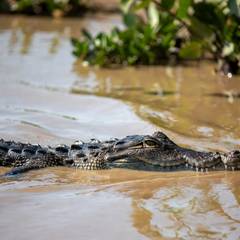
Strip away the exaggeration and the anaconda is still a remarkable animal. Its eyes and nostrils sit on top of its head so it can lie almost entirely submerged with nothing showing. It is clumsy and slow on land, where its own weight works against it, and transformed in water. Females are far larger than males, which is the reverse of the usual pattern in snakes. And it gives birth to live young rather than laying eggs, sometimes twenty or more at a time, each already able to swim and hunt.
It is the heaviest snake alive rather than the longest, a distinction the green anaconda Beastfile holds onto.
Sources
Last reviewed 9 Aug 2026 · 3 sources
Written by Michael Ryan
Mike keeps two rescued bearded dragons, Dex and Cera, and writes the care guides on BeastlyFacts from his own research and mistakes. He is not a veterinarian.
More about Michael Ryan →Comments
No comments yet - be the first!